The Beautiful Simplicity of the Rapture
Why the true Church cannot, must not, and will not go through the Tribulation;
or Why all born-again believers in Jesus will be raptured at any moment!
Paul Wilkinson, December 10, 2024
This illustrated booklet is the basis for my 2024 Pre-Trib presentation, and was written primarily for Gypsy believers within the Light & Life Missions movement. It was written in a conversational style to break down some of the main arguments for a pre-trib Rapture. It was also the basis for my forthcoming book, “The Beautiful Simplicity of the Rapture – A Gypsy Testimony.”
Why this Booklet?
The purpose of this booklet is to help every one of us answer the question, “When is the Rapture going to happen?” Don’t worry, I won’t be tickling your ears (2 Timothy 4:3) by setting a date for the Rapture – you have my permission to stone me if I ever do that! Well, stoning might be a little extreme, but you get the point – we should have nothing to do with date-setting Gorgers (or Gypsies)! What I will be doing in this booklet is looking at the timing of the Rapture as it relates to the Tribulation to come. To do that we need to know, of course, what the Rapture is and what the Tribulation is, and so we will be taking it nice and slow to make sure nobody gives up before reaching the end. This booklet has not been written for so-called “clever” people, or just for people who can read – and it hasn’t been written only for pastors, ministers, and teachers. I have prayerfully written it in the hope that, by God’s grace, everyone will be able to understand as much as the Lord Jesus wants each person to understand. I hope that by the end of the booklet you will be glad and not sad that you started reading it, or started listening to it being read to you. Above all, I hope this booklet will awaken within each one of us a deeper longing to be with our Lord, God, and Saviour Jesus Christ. As the Apostle Paul wrote in one of his letters, “My desire is to depart and be with Christ, for that is far better.” (Philippians 1:23) If there are to tears along the way, then I pray they will be tears of joy and excitement, not tears of frustration and confusion.
The question we are looking at continues to divide Christians all over the world, be they Jew or Gentile, Gypsy or Gorger. But it shouldn’t. I believe the Bible gives a very clear answer as to when the Rapture is going to happen. As the Apostle Paul wrote in one of his letters, “God is not a God of confusion, but of peace” (1 Corinthians 14:33). So, wherever there is confusion, disunity, and even fighting among believers over what the Bible teaches, we know that God is not behind it and that He never intended it! But keep one thing in mind as we begin our journey together. Like many other doctrines or truths of the Bible, the timing of the Rapture cannot be proved from one verse, or even a couple of verses; it’s never quite that simple with God’s Word. Try proving from one verse, for example, that there is only one God, that He is One, and that He is three Persons (i.e. the Trinity). To do so, we have to look at what the whole of the Bible has to say, from Genesis at the very beginning to Revelation at the very end. This is what the Apostle Paul called “the whole counsel of God” (Acts 20:27).
The Bible tells us that as we “run the race” marked out for us by the Lord Jesus Christ, “we are surrounded by so great a cloud of witnesses” (Hebrews 12:1). Here is what some of those witnesses, who were well known in the Church of their day, said before they finished their race. Please note: As you read through the booklet, sometimes you will see words in brackets that look like this [ ] rather than like this ( ). What is written inside these square brackets [ ] is what I have added to hopefully make things a little easier to understand:
“Perhaps He will appear as the day-spring from on high, before the morning light. O do not set Him a time. Expect Him every hour. Now, He is nigh, even at the door!” John Wesley, 1703-1791
“The Lord is coming, dear brother; the time for the world is passing away. What a blessing! May God find us watching, and thinking only of one thing ... Jesus, our precious Saviour.” John Nelson Darby, 1800-1882
“It is good and right to preach Christ incarnate [became a man], Christ crucified, Christ risen, Christ ascended, but if we would be true to Scripture we must add one more note – Christ returning, Christ coming again ... If we really belong to Him, if we really believe in Him, we shall love His appearing, we shall long for His coming again.” Francis Webster, 1859-1920
“It is certain ... that we ought to be expecting His return for His people at any moment.” Amzi Clarence Dixon, 1854-1925
“He is coming, and we know neither the day, nor the hour, when He may come. What if He should come now?” William E. Blackstone, 1841-1935
“Historically, belief in the any-moment-coming of Christ ”¦ produces an evangelistic church of soul-winning Christians, for when we believe Christ could appear at any moment, we seek to share Him with our friends [and our enemies] lest they be left behind at His coming.” Tim LaHaye, 1926-2016
What is the Rapture?
Here are three scriptures for us to look at as we begin our study. Please take special note of the words I have highlighted in bold:
1. During the last Passover supper, the Lord Jesus made this incredible promise:
“Let not your hearts be troubled. You believe in God; believe also in me. In my Father’s house are many rooms [or mansions]. If it were not so, would I have told you that I go to prepare a place for you? And if I go and prepare a place for you, I will come again and will take you to myself, that where I am you may be also.” (John 14:1-3)
2. About twenty years later, in his first letter to the church in the Greek city of Thessalonica, the Apostle Paul wrote these wonderful words of encouragement:
“13But we do not want you to be uninformed, brothers, about those who are asleep, that you may not grieve as others do who have no hope. 14For since we believe that Jesus died and rose again, even so, through Jesus, God will bring with Him those who have fallen asleep. 15For this we declare to you by a word from the Lord, that we who are alive, who are left until the coming of the Lord, will not precede those who have fallen asleep. 16For the Lord Himself will descend from Heaven with a cry of command, with the voice of an archangel, and with the sound of the trumpet of God. And the dead in Christ will rise first. 17Then we who are alive, who are left, will be caught up together with them in the clouds to meet the Lord in the air, and so we will always be with the Lord. Therefore encourage one another with these words.” (1 Thessalonians 4:13-18)
3. And in his first letter to the church in Corinth, which was also in Greece, Paul wrote:
“Behold! I tell you a mystery. We shall not all sleep, but we shall all be changed, in a moment, in the twinkling of an eye, at the last trumpet. For the trumpet will sound, and the dead will be raised imperishable, and we shall be changed.” (1 Corinthians 15:51-52)
With these verses in mind, we can say this: The Rapture is the moment when you and I as Christians – and all those who have put their faith and trust in the Lord Jesus Christ during the past two thousand years – will be suddenly changed, caught up to meet Him in the air, and taken to the Father’s house in Heaven. Here are a couple of things for us to think about:
- When the truth about the Rapture is taught, God’s people are more easily encouraged, strengthened, and prepared for the future. We are better able to understand what is happening in the world right now, because we are joyfully looking for the Lord Jesus to come and take us Home.
- When the truth about the Rapture is not taught, God’s people are more easily discouraged, weakened, and unprepared for the future. We are less able to understand what is happening in the world right now, because we are fearfully looking for the Antichrist to come and make our lives a misery.
In his letter to Titus, the Apostle Paul referred to the Rapture as “our blessed hope” (Titus 2:13). I believe what Paul meant by these three words is that God has filled this hope with blessing for those who hold it tightly in their hearts. When we truly love and cherish the truth about the Rapture, then there are blessings to be received from our Lord, such as encouragement, strength, assurance, joy, peace, and a deep sense of security. But when we do not love and cherish the truth about the Rapture – and for many Christians that can happen simply because they haven’t been taught the truth about it – then we are robbed of these blessings. Now consider this question for a few moments: What do you yourself think is the main reason why the Lord Jesus saved you? Don’t read on any further until you’ve stopped to think carefully about this question.
Here is my suggestion. I believe the main reason why the Lord Jesus saved us is so that one day – and it could be TODAY – we will see Him as He is and be with Him where He is, forever and ever throughout all eternity! Our Saviour became one of us, hung on that cruel Cross and died in our place, because He loved us with an indescribable and incomparable love. He wanted us to be with Him forever, and the only way that could happen was through the Cross. On the day of the Rapture, you and I will be where our Lord is right now, in our new resurrection bodies – no more sin, suffering, or sadness; no more tears, troubles, or trials (1 Corinthians 15:50-57; 1 John 3:2). What a blessed hope we have! What a blessed Redeemer we belong to!
A Word from the Lord
Please read again those verses in 1 Thessalonians 4, which I quoted above. Now look carefully at verse 15. All that the Apostle Paul wrote here was in response to a specific revelation which the Lord Jesus had given him. In other words, he was not sharing his own opinions and beliefs about the Rapture; he was bringing a “word from the Lord.” This tells us that the doctrine of the Rapture is not the teaching of man, but the revelation of God.
Now, I may be stating the obvious when I say that no-one spoke English back in those days. Paul, Peter, James, Jude, and John all wrote in the Greek language. In fact, the Holy Spirit inspired the whole of the New Testament to be written in Greek, since that was the international language of the day. The Holy Spirit also inspired most of the Old Testament to be written in Hebrew, since that was the language spoken by God’s people Israel. You and I are blessed to have Bibles that are English translations of the original Hebrew Old Testament and Greek New Testament. So then, if you were reading the actual letter Paul wrote to the Thessalonians, then our main Rapture verse (verse 17) would look a lot like this:
17ἔπειτα ἡμεῖς οἱ ζῶντες οἱ περιλειπόμενοι ἅμα σὺν αὐτοῖς ἁρπαγησόμεθα ἐν νεφέλαις εἰς ἀπάντησιν τοῦ κυρίου εἰς ἀέρα καὶ οὕτως πάντοτε σὺν κυρίῳ ἐσόμεθα
How’s your Greek? I had a feeling you might say that. The Greek word in bold black above is the key to this verse. It comes from the Greek word ἁρπάζω. Don’t worry, don’t panic, and please don’t switch off at this point and switch on your phone instead! We don’t all have to know Greek to understand God’s Word, praise the Lord!
- Here is how this funny-looking Greek word is usually written in our English language:
harpazō - Here is how we should say this Greek word in English:
har – pad – zo
Now try saying it out loud a few times. Well done! You just spoke Greek, the way the Apostle Paul and the Thessalonians did (well, maybe with a slightly different accent to theirs!)
Not only that, but I believe har-pad-zo is one of the most amazing words that the Holy Spirit ever gave to the Church, because it is full of HOPE, ENCOURAGEMENT, and BLESSING. But what does it actually mean? In your own Bible, and in pretty much every English Bible out there, you will see two words which have been used to translate har-pad-zo. Those words are “caught up.” To understand what they mean, and why the Apostle Paul used har-pad-zo in his first letter to the Thessalonians, let us look at some of the other verses in our Bibles where this Greek word is used. After each verse, I will put this Greek word in a red box and its English translation in bold black letters above the red box. [Note: Please see the associated PDF for these features]. Ready? Here we go:
- “From the days of John the Baptist until now the kingdom of heaven has suffered violence, and the violent take it by force.” (Matthew 11:12)
take it by force = harpadzo
- “When Jesus perceived that they were about to come and take Him by force to make Him king, He departed again to the mountain by Himself alone.” (John 6:15)
take Him by force = harpadzo
- “And when the dissension became violent, the tribune, afraid that Paul would be torn in pieces by them, commanded the soldiers to go down and take him by force from among them and bring him into the barracks.” (Acts 23:10)
take him by force = harpadzo
- “When anyone hears the word of the kingdom, and does not understand it, then the wicked one comes and snatches away what was sown in his heart.” (Matthew 13:19)
snatches away = harpadzo
- “My sheep hear my voice, and I know them, and they follow me. I give them eternal life, and they will never perish, and no one will snatch them out of my hand. My Father, who has given them to me, is greater than all, and no one is able to snatch them out of the Father’s hand.” (John 10:27-29)
snatch them = harpadzo
- “And have mercy on those who doubt; save others by snatching them out of the fire; to others show mercy with fear ....” (Jude 22-23)
snatching them = harpadzo
So, then, from all these verses we can see that our Greek word harpadzo was used at different times whenever someone, or something, was being taken or snatched away ....
- by someone else
- from one place to another
- by force
- suddenly
- from danger
Question: Some Christians who don’t believe in the Rapture have argued like this: “But the word Rapture isn’t even in the Bible.” Do they have a point?
Answer: No they don’t! The word “Trinity” isn’t in the Bible either! Words like “Rapture” and “Trinity” are theological words, not Biblical words. What I mean is this: they are not found in any of our English Bibles. They were coined, or invented, a long time ago by theologians in the Church [men dedicated to studying everything to do with God]. These theological words were intended to help Christians better understand certain truths that are in our Bibles. Consider these facts:
- About 1800 years ago, a theologian by the name of Tertullian (who was born in the ancient city of Carthage in modern-day Tunisia), came up with the Latin word Trinitas. Centuries later this word was translated into English as “Trinity.” Tertullian hoped it would help believers understand that God is One (Deuteronomy 6:4), and also that He is Father, Son, and Holy Spirit (Matthew 28:19).
- Here’s a bit more history for you. Latin was a language that was first spoken by certain groups of people who lived along the Tiber River, which flows through the city of Rome. Latin spread widely as the Roman Empire expanded, and eventually replaced Greek as the main international language of the day. As the church in Rome grew, so Latin became more widely used by theologians such as Tertullian. It eventually became the language used by the Roman Catholic Church to impose its authority and control, even though it died out as a spoken language long before then. William Tyndale was one man who defied the Pope and the Catholic Church. He translated the Bible into English so that everyone could read God’s Word for themselves. This ultimately cost him his life – the Catholic Church executed Tyndale by tying him to a stake, strangling him to death, and setting his body on fire. We owe William Tyndale an enormous debt, and we’ll be able to thank him personally one day, praise the Lord!
PLEASE NOTE: If the doctrine, or truth, of the Trinity wasn’t in the Bible, then both the Bible and our Christian faith would fall apart. But it is in the Bible, even though the actual word “Trinity” isn’t. Just like the doctrine of the Trinity, the doctrine of the Rapture is in the Bible, even though the word itself isn’t. Once again, keep in mind the fact that not every Bible is written in English! Take a look again at our main Rapture verse, which is 1 Thessalonians 4:17. This is how it is written in my own Bible, which is the English Standard Version (ESV):
- “Then we who are alive, who are left, will be caught up together with them in the clouds to meet the Lord in the air, and so we will always be with the Lord.”
We have seen already what this verse looks like in the original Greek language. If you thought Greek was bad enough, now take a look at what this verse looks like when written in Latin, in what is known as the Latin Vulgate Bible:
- “deinde nos qui vivimus qui relinquimur simul rapiemur cum illis in nubibus obviam Domino in aera et sic semper cum Domino erimus”
Question: Aren’t you glad you don’t speak Latin?
Question: Doesn’t that word rapiemur look, and sound, a little familiar?
Try saying it out loud.
Answer: This is the Latin word which was translated into English using the words “caught up.” It is from this Latin word rapiemur that we get our English word rapture (even though the word “rapture” itself isn’t in our English Bibles). Take a look at these pictures: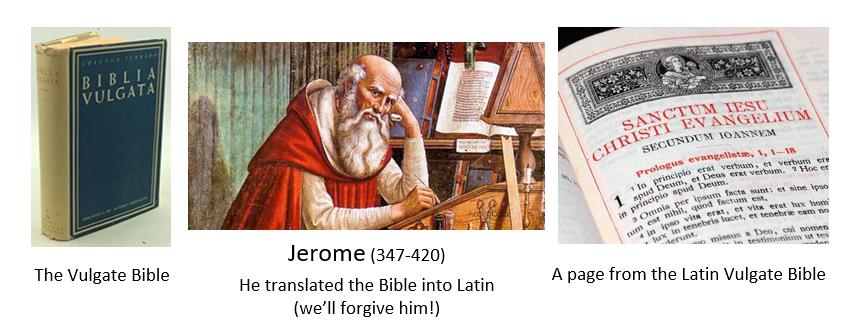
With all this in mind, then, let us look once again at some of those Rapture verses which speak about being snatched away. Now that you can all speak and understand Latin (rapiemur) as well as Greek (harpadzo) – stay humble now – let us see this Latin word as it appears in those same verses in the Latin Vulgate Bible. Actually, what you will see are words that are connected to rapiemur – they won’t all look and sound exactly the same because of the way Latin works, but they all come from the same family of words. If this is getting a bit technical, don’t worry (put that phone down, I saw you!) The important thing is to look at the first 3 letters of each Latin word below. Hang in there, it will all become clear, I promise/hope/pray. Here we go then, hang on to your hats, it could get a little bumpy:
- “When Jesus perceived that they were about to come and take Him by force to make Him king, He departed again to the mountain by Himself alone.” (John 6:15)
take Him by force = harpadzo (Greek)
= raperent (Latin)
In other words, after the 5,000 men (plus women and children) were miraculously fed by the Lord Jesus, the crowd wanted to “rapture” Him.
- “And when the dissension became violent, the tribune, afraid that Paul would be torn in pieces by them, commanded the soldiers to go down and take him by force from among them and bring him into the barracks.” (Acts 23:10)
take Him by force = harpadzo (Greek)
= rapere (Latin)
In other words, the Roman soldiers were sent to “rapture” the Apostle Paul from those who were trying to kill him.
- “My sheep hear my voice, and I know them, and they follow me. I give them eternal life, and they will never perish, and no one will snatch thema out of my hand. My Father, who has given them to me, is greater than all, and no one is able to snatch themb out of the Father’s hand.” (John 10:27-29)
snatch them = harpadzo (Greek)
= rapieta / rapereb (Latin)
In other words, the Lord was saying that it is impossible for those of us who are His sheep to be “raptured” out of God’s hand.
It’s a “Rap”
Let’s now take a moment, and a breath (and maybe a cup of coffee or can of Red Bull), and try and pull all of these threads together to see what we’ve learned so far:
- The New Testament was originally written in the Greek language, and not in English.
- The Greek word har-pad-zo was inspired by the Holy Spirit. It was used by men such as the Gospel writer Luke and the Apostle Paul in verses which speak about being snatched away suddenly.
- Jerome was the man who, long ago, translated the Hebrew Old Testament and the Greek New Testament into the Latin language. He was asked to do so by Pope Damasus I. His translation became known as the Vulgate Bible, and was the official Bible of the Roman Catholic Church.
- In the Vulgate Bible we see that the Greek word harpadzo was put into Latin using words like rapere, rapiet, raperent, and rapiemur.
- It is from this family of Latin “rap” words that we get our English word “rapture.”
- Those who translated the Bible into English used the words “caught up” instead of “rapture” to describe the sudden snatching away of believers from the Earth.
- The only reason I can think of as to why “caught up” was used in our English Bibles instead of “rapture,” is because these words are easier to understand. They describe very well what is going to happen to us – we will be caught up to meet the Lord Jesus in the air. If we were reading 1 Thessalonians 4:17 for the very first time, and we read the word “rapture” instead of “caught up,” we would need someone to explain to us what it meant, because it isn’t a word that is commonly used today. That’s because it is a theological word that was given to us by theologians in the Church.
But there’s more!
Just when you thought “no more Greek or Latin for me,” we have three more amazing verses to look at. I hope these will help tie everything together, and encourage us all. Here they are then, with the Greek and Latin words written underneath the key words in bold black:
- “When they came up out of the water, the Spirit of the Lord carried Philip away, and the eunuch saw him no more, and went on his way rejoicing. But Philip found himself at Azotus ....” (Acts 8:39)
carried away = harpadzo (Greek)
= rapuit (Latin)
In other words, the Holy Spirit raptured Philip to another place.
- “I know a man in Christ who fourteen years ago was caught up to the third heaven – whether in the body or out of the body I do not know, God knows. And I know that this man was caught up into paradise – whether in the body or out of the body I do not know, God knows – and he heard things that cannot be told, which man may not utter.” (2 Corinthians 12:2-4)
caught up = harpadzo (Greek)
= raptum (Latin) [first reference]
= raptus (Latin) [second reference]
In other words, the Apostle Paul was raptured to Paradise.
- “She gave birth to a male Child, one who is to rule all the nations with a rod of iron, but her Child was caught up to God and to His throne ....” (Revelation 12:5)
caught up = harpadzo (Greek)
= raptus (Latin)
In this chapter of Revelation, the Apostle John is shown a great red dragon [Satan/the Devil]. The dragon is standing before a woman [Israel] wearing a crown of 12 stars [the 12 tribes]. The woman is pregnant with a male child [the Messiah, the Lord Jesus], and the dragon is waiting to destroy Him. Satan is thwarted by God, and the Lord Jesus is raptured to Heaven [His Ascension].
The “rapture” of the Lord Jesus in Revelation 12:5 is important for us in our study. The Lord was given a new resurrection body after He was crucified and before He ascended to the Father. Our blessed hope as believers is that one day we too will be given a new resurrection body like our Lord’s, and we too will ascend (be raptured) to Heaven. Consider the first chapter of Acts, which helps explain Revelation 12:5 in more detail. In these verses we are told what happened the last time the Lord Jesus was with His Disciples on Earth:
“And when He [the Lord Jesus] had said these things, as they were looking on, He was lifted up, and a cloud received Him out of their sight. And while they were gazing into heaven as He went, behold, two men stood by them in white robes, and said, ”˜Men of Galilee, why do you stand looking into heaven? This Jesus, who was taken up from you into heaven, will come in the same way as you saw Him go into heaven.’” (Acts 1:9-11)
Notice what happened to the Lord Jesus: He was “lifted up,” He was “received” into a cloud, and He was “taken up” into heaven. We don’t find our Greek word harpadzo here in the original Greek New Testament, and we don’t find any of those Latin “rap” words in the Vulgate New Testament. However, what we can say – especially if we connect these verses to Revelation 12:5 – is that the Lord Jesus was raptured from the Earth at His Ascension. In other words, something dramatic happened to Him; He didn’t vanish into thin air or fly away – He was lifted up and taken away. The main difference between the Lord’s own rapture and the rapture of the Church, is that when you and I are taken from the Earth it will happen very suddenly, “in the twinkling of an eye,” as we will see when we look at 1 Corinthians 15. The Disciples saw the Lord Jesus ascend, but no-one will see us go when the Lord comes for us!
Do not be troubled, JESUS IS COMING!
When we are at our lowest and weakest point as believers, in deep grief and agony of heart, we need the promises of God to hold onto, don’t we? In what many (including myself) believe to be the first reference in the Bible to the Rapture of the Church, the Lord Jesus made an incredible promise. He did so to comfort His Disciples during their last Passover meal together. Here is what He said to them:
“Let not your hearts be troubled. You believe in God; believe also in me. In my Father’s house are many mansions. If it were not so, would I have told you that I go to prepare a place for you? And if I go and prepare a place for you, I will come again and will take you to myself, that where I am you may be also.” (John 14:1-3)
The Lord Jesus is coming to take His people to Himself, praise His Name! If He had been talking here about believers going to Heaven when they die, then He would have had to come again and again and again ... and again ... for the millions of Christians who have gone before us. This makes no sense whatsoever, and yet this is what many in the Church have been teaching for centuries. I believe the Lord was introducing the Disciples to the glorious truth of the Rapture, a truth which the Apostle Paul would later explain in more detail after the Church was established.
The background, or context, to what the Lord Jesus was saying here in John 14 is that of a Jewish wedding. In ancient times, the Jewish bridegroom would leave his chosen bride to go and prepare a home for them. That home would be an annex to his father’s house. In other words, it would be joined to it and therefore be a part of it. The bride did not know how long the bridegroom would be gone, so she had to be ready at all times for when he appeared and took her to the wedding feast, and to their new home. The Lord Jesus didn’t give His disciples any time-frame as to when He would come for them, and He didn’t speak here about any world events that would have to take place beforehand. He simply comforted His Disciples with the promise that He would come and take them Home!
Before we continue, I’d like to share the following story about Queen Victoria, who reigned on the British throne for nearly 64 years (1837-1901). She was a true Christian, or at least that’s what I’ve read and heard over the years. I have no reason to doubt the following story, but I can’t prove for certain whether or not it’s true (although I don’t know why anyone would make it up if it wasn’t true):
Queen Victoria was in the habit of visiting a number of her old servants to whom she had given little homes on her estate. She was very fond of one old lady who had given her long and faithful service in years gone by. She would go and sit with her and while knitting, they would talk together.
On one occasion, a niece of the old servant stepped in to see her aunt. After a while, the Queen read the 14th chapter of John’s Gospel. Then closing the Bible, the Queen asked the young girl, “My child, are you a Christian?”
“I certainly am, your Majesty,” was the answer.
“How do you know you are?” continued the Queen.
“Well, I was baptized, then confirmed.”
“Good! Now let us pray together,” said the Queen, so she prayed, “Please, Lord, open the eyes of this young girl so that she may learn that she cannot be a child of Thine until her heart is changed. Help her to see her state of sinfulness before Thee. Direct her gaze toward the cross of Christ, so that she may believe that He gave Himself for her, and may she learn that no external religious practice can save her soul.”
The young girl took Christ as her Saviour, and the great joy of her life was to tell others of her own salvation. She would say, “I have often sung ”˜God save the Queen,’ but I never thought that the Queen herself would ask God to save me!”
Not by works of righteousness which we have done, but according to His mercy He saved us. (Titus 3:5)
In my Father’s house are many mansions: if it were not so, I would have told you. I go to prepare a place for you. If I go and prepare a place for you, I will come again, and receive you unto myself. (John 14:2-3)
God’s house is filling fast – “Yet there is room!”
Some guest will be the last – “Yet there is room!”
(“A Story of Queen Victoria,” in Messages of God’s Love, 1969 – www.bibletruthpublishers.com)
What day is it?
How easy it can be for us as Christians to read the Bible, and skip over words which we may not think are that important. “Speak for yourself,” did I hear someone say? Well, take a look at the verses below, but don’t be too quick to read them. Stop and ask yourself what you think the Apostles had in mind when they used the two small words I have highlighted in bold black letters:
- “The night is far gone; the day is at hand. So then let us cast off the works of darkness and put on the armour of light” Romans 13:12
- “as you wait for the revealing of our Lord Jesus Christ, who will sustain you to the end, guiltless in the day of our Lord Jesus Christ” 1 Corinthians 1:7-8
- “each one’s work will become manifest, for the day will disclose it, because it will be revealed by fire” 1 Corinthians 3:13
- “that on the day of our Lord Jesus you will boast of us as we will boast of you” 2 Corinthians 1:13-14
- “And do not grieve the Holy Spirit of God, by whom you were sealed for the day of redemption” Ephesians 4:30
- “And I am sure of this, that He who began a good work in you will bring it to completion at the day of Christ Jesus” Philippians 1:6
- “so that you may approve what is excellent, and so be pure and blameless for the day of Christ” Philippians 1:10
- “holding fast to the word of life, so that in the day of Christ I may be proud that I did not run in vain or labour in vain” Philippians 2:16
- “But I am not ashamed, for I know whom I have believed, and I am convinced that He is able to guard until that day what has been entrusted to me” 2 Timothy 1:12
- “I have fought the good fight, I have finished the race, I have kept the faith. Henceforth there is laid up for me the crown of righteousness, which the Lord, the righteous Judge, will award to me on that day, and not only to me but also to all who have loved His appearing” 2 Timothy 4:7-8
- “And let us consider how to stir up one another to love and good works ... and all the more as you see the day drawing near” Hebrews 10:24-25
- “And we have something more sure, the prophetic word, to which you will do well to pay attention ... until the day dawns and the morning star rises in your hearts” 2 Peter 1:19
My question is simply this: which “day” were the Apostles referring to? Which “day” were they encouraging believers to be constantly thinking about, expecting, and preparing for? Was it the day when the Lord Jesus finally returns to Earth to destroy the Antichrist, save Israel, judge the nations, and reign from Jerusalem for a thousand years? These are definitely some of the things that will happen at the Second Coming, but are they what the Apostles had in mind when they were writing to all the different churches? To answer that question, take a look at one of the longest prophecies of the Second Coming in the Old Testament. It speaks about a particular day, but see whether you think it is the same “day” that the Apostles were referring to in their letters:
“Behold, a day is coming for the Lord, when the spoil taken from you will be divided in your midst. For I will gather all the nations against Jerusalem to battle, and the city shall be taken ... Half of the city shall go out into exile ... Then the Lord will go out and fight against those nations as when He fights on a day of battle. On that day His feet shall stand on the Mount of Olives that lies before Jerusalem on the east, and the Mount of Olives shall be split in two from east to west by a very wide valley, so that one half of the Mount shall move northward, and the other half southward ...
Then the Lord my God will come, and all the holy ones with Him. On that day there shall be no light, cold, or frost. And there shall be a unique day, which is known to the Lord, neither day nor night, but at evening time there shall be light. On that day living waters shall flow out from Jerusalem, half of them to the eastern sea and half of them to the western sea ... And the Lord will be king over all the earth. On that day the Lord will be one and His name one.” (Zechariah 14:1-9)
In this very important prophecy, a number of dramatic words are used to describe what is going to happen at the Second Coming: words like spoil, plunder, exile, fight, and battle. We read about the nations gathering, a mountain splitting, living waters flowing, people fleeing, the holy ones coming, and a day dawning which will be like no other in the history of planet Earth. Not only that, but the exact location where all this is going to happen is also given – Jerusalem, Israel. And we are told, most importantly, that the feet of the Lord Jesus “shall stand on the Mount of Olives” (verse 4). In other words, the Second Coming will be a visible event seen by everyone. It will be the most dramatic, and most terrifying, day in the history of the world. All kinds of things are going to happen on that day, but they are all going to take place here on Earth, in and around Jerusalem, in the land of Israel.
Now go back and take a minute to re-read those verses about “the day” the Apostles were writing about, and see if “the day” they had in mind sounds like “the day” the prophet Zechariah had in mind when he prophesied about the Second Coming.
I wonder if you came to this conclusion: These “days” are not the same!
Well done if you did. Bravo! Très bien! Gut gemacht!
That’s because the day the Apostles were writing about is the day of the Rapture, but the day the Prophets were writing about is the day of the Second Coming. The Rapture and the Second Coming are NOT the same event and do NOT happen at the same time – these “days” are NOT the same! It is critically important for us all to understand this.
Here are a few more prophecies of the Second Coming, just to make this clearer. As you read through them, look out for the dramatic words and events that are used to describe the Lord’s return to Earth. This time I have quoted prophecies from the New Testament:
- “For as the lightning comes from the east and shines as far as the west, so will be the coming of the Son of Man. Wherever the corpse is, there the vultures will gather. Immediately after the tribulation of those days the sun will be darkened, and the moon will not give its light, and the stars will fall from heaven, and the powers of the heavens will be shaken. Then will appear in heaven the sign of the Son of Man, and then all the tribes of the earth will mourn, and they will see the Son of Man coming on the clouds of heaven with power and great glory.” (Matthew 24:27-30)
- “For the mystery of lawlessness is already at work. Only He who now restrains it will do so until He is out of the way. And then the lawless one [the Antichrist] will be revealed, whom the Lord Jesus will kill with the breath of His mouth and bring to nothing by the appearance of His coming. The coming of the lawless one is by the activity of Satan with all power and false signs and wonders, and with all wicked deception for those who are perishing, because they refused to love the truth and so be saved.” (2 Thessalonians 2:7-10)
- “Behold, He is coming with the clouds, and every eye will see Him, even those who pierced Him, and all tribes of the earth will wail on account of Him.” (Revelation 1:7)
- “Then I saw heaven opened, and behold, a white horse! The one sitting on it is called Faithful and True ... His eyes are like a flame of fire, and on His head are many diadems, and He has a name written that no one knows but Himself. He is clothed in a robe dipped in blood, and the name by which He is called is The Word of God. And the armies of heaven, arrayed in fine linen, white and pure, were following Him on white horses. From His mouth comes a sharp sword with which to strike down the nations, and He will rule them with a rod of iron. He will tread the winepress of the fury of the wrath of God the Almighty. On His robe and on His thigh He has a name written, King of kings and Lord of lords.” (Revelation 19:11-16)
Aren’t these prophecies absolutely incredible? It’s going to happen, brothers and sisters – but only AFTER we have been raptured!
Whenever the Apostles wrote about “the day,” or “that day,” or “the day of redemption,” or “the day of Christ Jesus,” they were doing so to help and encourage the Church. They were talking about what is going to happen to believers, and not to the nations and people of the world. Notice that they never wrote anything about Israel, Jerusalem, the nations of the world, the Antichrist (with one exception), Armageddon, or any of the dramatic events that will happen one day here on Earth. Everything the Apostles wrote about in connection with that “day” was to do with believers living godly lives, shunning evil, finishing the race, encouraging one another, and preparing to meet the Lord Jesus in the air. Isn’t this also in keeping with everything we read in the New Testament, about our focus being Heaven, not Earth? Consider these verses:
- “But our citizenship is in Heaven, and from it we await a Saviour, the Lord Jesus Christ, who will transform our lowly body to be like His glorious body, by the power that enables Him even to subject all things to Himself.” (Philippians 3:20-21)
- “Set your minds on things that are above, not on things that are on earth. For you have died, and your life is hidden with Christ in God. When Christ who is your life appears, then you also will appear with Him in glory.” (Colossians 3:2-4)
- “These all died in faith ... having acknowledged that they were strangers and exiles on the earth. For people who speak thus make it clear that they are seeking a homeland ... But as it is, they desire a better country, that is, a heavenly one.” (Hebrews 11:13)
- “Beloved, we are God’s children now, and what we will be has not yet appeared; but we know that when He appears we shall be like Him, because we shall see Him as He is. And everyone who thus hopes in Him purifies himself as He is pure.” (1 John 3:2-3)
Maybe this might help ...
The Prophets in the Old Testament were concerned with earthly matters. They prophesied of things which God said would happen that are connected to the Earth, especially things to do with His earthly people, Israel.
- Israel is a physical nation with a land, borders, and a capital city
- God has promised that Israel will be rescued and restored as a nation here on Earth
The Apostles in the New Testament were concerned with heavenly matters. They spoke of things which the Lord said would happen that are connected to Heaven, especially things to do with His spiritual people, the Church.
- The Church is a spiritual nation without a land, borders, or capital city
- The Lord Jesus has promised that the Church will be resurrected and raptured from the Earth
So then,
- Do not confuse Israel and the Church – they are two different peoples of God!
- The Church is not “the new Israel,” or “spiritual Israel” – this is false teaching (called Replacement Theology) that has been around for nearly 2,000 years.
- Christians are not “spiritual Jews” (unless they are Jewish believers in Jesus).
- Promises given to Israel in the Old Testament are for Israel, and promises given to the Church in the New Testament are for the Church. Don’t mix them up!
Only when we understand these differences can we see clearly what the future holds for Israel, and what the future holds for the Church – and Who it is that holds their futures!
The Mystery of the Rapture
The Bible says so much about the Second Coming of Jesus. There are hundreds of prophecies in the Old Testament, and many in the New. However, when the Old Testament prophecies were given to Israel – beginning with Moses and ending with John the Baptist – the Jews believed that there was going to be ONE coming of Messiah, who would save Israel and reign over the Earth. Even though the Prophets did prophesy about the suffering, death, and resurrection of Messiah (Psalm 22, Isaiah 53, Daniel 9), the Jewish people were not expecting Him to die, rise again, ascend to Heaven, and centuries later return to reign. This is why Simon Peter wanted to build three booths, or tabernacles, on the Mount of Transfiguration for Jesus, Moses, and Elijah (Mark 9:5), and why the crowds welcomed the Lord on Palm Sunday with cries of “Hosanna! Blessed is He who comes in the name of the Lord! Blessed is the coming kingdom of our father David! Hosanna in the highest!” (Mark 11:9-10)
One illustration has been used by Bible teachers over the years to help explain all this.
What the Prophets saw, in terms of the coming of Messiah, was like the mountain peak in the photograph below. This was to be the great, towering event in world history when God would fulfil all His prophecies and promises in the most dramatic fashion. What they didn’t understand, however, was that Messiah would come twice – first to die for the sin of Israel and the sin of the world, and a second time to rule and reign over Israel and over the world. Like the man in the photograph below, they didn’t realise that much more lay beyond the great mountain peak – 2,000 more years of history, full of mountains and valleys!

So we see that many things were spoken by the Prophets about the event which you and I now know to be the Second Coming of Christ. But they knew nothing at all about the Rapture, and so were completely silent about it. The Rapture was kept hidden by God throughout the Old Testament era, because the future Church was kept hidden by God. The Church is not found anywhere in the Old Testament. Why is this so important? Good question, thanks for asking!
It is important because it means that not one of the promises and prophecies of God in the Old Testament were about, or for, the Church! This means that you and I are not allowed to put the Church back into the Old Testament, and claim for the Church any of the prophecies and promises that were given to Israel. This is called stealing! Yet this is what so many in the Church have been guilty of for centuries, especially in our day.
PLEASE NOTE: This does not mean that there isn’t anything in the Old Testament that applies to us as believers. I’m not saying that at all, not for one second! All of God’s Word is for us, and the Holy Spirit can apply any part of it to our lives at any time and in so many ways. Praise the Lord! As the Apostle Paul wrote to Timothy, all Scripture is God-breathed, or inspired by God, for our use (2 Timothy 3:16). So we can say that the whole of the Bible is important and beneficial to us, but that doesn’t mean it all applies to us. Does that make sense? This is why we need to know how to handle God’s Word properly, and to do that we always need to know who is speaking to who, when, where, how, and why.
All those who insist that the Jewish people are no longer important because God rejected and replaced them with the Church (this is called Replacement Theology) are guilty of a terrible crime against God and His Word. They have stolen promises and prophecies that God gave long ago to Israel, and which He will fulfil for Israel and only for Israel. God is faithful!
See if this illustration helps:
|
Imagine if I came to your house or trailer one day, and I saw an unopened letter on the table that was addressed to you. Imagine if I took that letter, opened it, and saw that it contained a promise from somebody’s will. That promise was for you to receive a large sum of money at a certain time in the future. Imagine if I then claimed that this money was really for me, because I was the one who opened the letter, and because I thought you didn’t deserve it anyway. Sounds crazy doesn’t it? You wouldn’t be too happy about it would you? But this is what so many in the Church have done to Israel; they have stolen what does not belong to them, what God did not promise them. It doesn’t matter whether we think Israel deserves the promised blessings of God or not, it was God who made those promises to Israel, and so only Israel can receive them. |
As we will see later, many Christians are guilty of doing exactly the same thing when it comes to the timing of the Rapture. They put the Church into Old Testament promises and prophecies that were not intended for her, but for Israel. This is why the Apostle Paul used a special word to explain all of this in his letters, and that word is mystery.
The Apostle Paul was uniquely chosen by the Lord Jesus to receive and to reveal God’s plan for the Church. In his letter to the Ephesians, Paul says how “the mystery was made known to me by revelation, as I have written briefly”. He then continues with these words:
“When you read this, you can perceive my insight into the mystery of Christ, which was not made known to the sons of men in other generations as it has now been revealed to His holy apostles and prophets by the Spirit. This mystery is that the Gentiles are fellow heirs, members of the same body, and partakers of the promise in Christ Jesus through the gospel.” (Ephesians 3:4-6)
This is why it was such a struggle, at first, for many of the early Jewish believers to accept the fact that the Lord was saving unclean Gentiles as well as them, making them equals. In the Church there was to be no more separation and distinction between Jew and Gentile, for in Christ there was only “one new man in place of the two” (Ephesians 2:15; Galatians 3:26-28). This would also mean, of course, that there would be no difference between Gypsy and Gorger! The mystery of the Church had now been revealed.
But Paul had more to say about “mystery”!
When I was growing up in the ’70s and ’80s, one of the most popular American detective series on British television was “Columbo.” Some of you may remember the scruffily-dressed detective who always wore a beige-coloured raincoat and smoked a cigar. At the end of every episode he would interrogate the person he believed had committed the crime. When he had finished, the brilliant detective would turn away, making it look as though he was about to leave. Just as the criminal thought that he or she was about to escape justice, Columbo would turn back. Touching his forehead or pointing with his cigar, he would then utter his famous catchphrase, “Oh, just one more thing.” One more line of questioning followed, the case was solved, the criminal was caught, Columbo was the hero, and the programme was over. You may be asking yourself: what has an American t.v. detective got to do with the Rapture? Good question, thanks for asking!
For nearly two thousand years a theological crime has been committed in the Church. In fact, many such crimes have been committed by theologians and teachers, by pastors and preachers, but here I am going to highlight just one. When it comes to understanding the future destiny of the Church, many Christians fall short. What I have just shared about the mystery of the Church is pretty much all they know and understand, and with some Christians it is perhaps all they want to know and understand. That is terribly sad, and not good enough. They may have some vague idea that one day the Lord will return, that there will be a judgment, and that they will spend eternity with Jesus in Heaven, but that’s about as far as it goes in their understanding of the end-times. But there was “one more thing” that the Apostle Paul had to say when speaking about the mystery of the Church, and it was this:
We won’t all die!
In his first letter to the Corinthians, Paul wrote these incredible words:
“I tell you this, brothers: flesh and blood cannot inherit the kingdom of God, nor does the perishable inherit the imperishable. Behold! I tell you a mystery. We shall not all sleep, but we shall all be changed, in a moment, in the twinkling of an eye, at the last trumpet. For the trumpet will sound, and the dead will be raised imperishable, and we shall be changed.” (1 Corinthians 15:50-52)
|
The word moment is the English word used in our Bibles to translate the Greek word atomō, which Paul used in verse 52. Does this Greek word look, and sound, familiar? Say it slowly to yourself (or to your husband, wife, or kids to impress them). This Greek word is where we get our English word “atom” from. An atom is the smallest particle in the entire universe. It is so incredibly tiny, that it can only be seen using the most powerful electron microscopes. Scientists estimate that inside an average-sized human body there are 6,500 million million million million atoms (that’s a lot of atoms!) The Apostle Paul was saying that it is impossible to measure the time it will take for our bodies to be changed at the Rapture. It will happen in a period of time as small as an atom, and much faster than you and I can blink! Try blinking as fast as you can; maybe get your kids to try it. Nope, not fast enough; the Rapture will happen much, much quicker than that! |
What Paul said in his letter to the Corinthians was in response to a revelation given to him by the Lord Jesus. This revelation was a mystery. As we saw earlier, a New Testament mystery is something never before revealed, something that is not found anywhere in the Old Testament, because it was hidden by God. Yes, we know from the Old Testament that Enoch and Elijah never died – we might say that both of them were suddenly “raptured” to Heaven (Genesis 5:24; 2 Kings 2:11). But nowhere in the Old Testament did God ever promise that this would happen to all His people; what happened to Enoch and Elijah was unique. The same will be true of the death, resurrection, and rapture of God’s “two witnesses” during the Tribulation. Unlike the Rapture of the Church, however, the whole world will be watching when these two witnesses (possibly Moses and Elijah?) ascend to Heaven in a cloud, after being killed by the Antichrist and raised to life again by God (Revelation 11:3-12).
Before the Lord Jesus began His Messianic ministry in Israel, the Jewish people had understood for centuries that one day there would be a resurrection of the dead. They believed that those who had been faithful to God would be raised to live forever with Him, while those who had been unfaithful would be raised to live forever away from Him (Daniel 12:1-3; Psalm 17:15; Job 19:25-27; Isaiah 26:19; Acts 24:15). However, Israel’s understanding of resurrection was limited and incomplete, until the Lord Jesus came and announced that those who believed in Him would live forever, and never die (John 5:21-29, 6:27-58). Following the death of Lazarus, the Lord told one of his grieving sisters, Martha, that He Himself was “the resurrection and the life” (John 11:21-27). Up to that point, Martha had understood what all devout Jewish people understood about resurrection. The Lord Jesus now brought her new revelation about the hope awaiting all those who belonged to Him.
All the way through 1 Corinthians 15, Paul spoke so wonderfully about the resurrection of the dead. He was emphatic in what he had to say to the believers in Corinth:
|
NO RESURRECTION = no Gospel, no forgiveness, no faith, no hope, and no Heaven |
Praise God, the Apostle Paul didn’t stop there, for in verses 20-21 he triumphantly declared:
“But in fact Christ has been raised from the dead, the firstfruits of those who have fallen asleep. For as by a man [Adam] came death, by a man [Jesus] has come also the resurrection of the dead. ”
|
RESURRECTION = the Gospel, forgiveness, faith, hope, and Heaven |
The Apostle Paul then continued his letter by explaining what that resurrection will mean for us as believers – that we will receive a new body like the Lord’s resurrection body, because the bodies we have now are not fit for Heaven. Paul then made the astonishing statement that we won’t all “fall asleep,” or die, but that we “shall all be changed, in a moment, in the twinkling of an eye, at the last trumpet.” In other words, at the Rapture!
Please do not confuse “the last trumpet” in 1 Corinthians 15, with the “seventh” and final trumpet in Revelation 11:
- The “last trumpet” is one of blessing, fulfilment, and hope. It will be the final call for all true believers to be gathered to the Lord Jesus, and it will end the Church age. The “seventh trumpet” is one of terror, judgment, and woe. It announces the final outpouring of God’s wrath during the Tribulation, and the beginning of Christ’s thousand-year reign on Earth.
- Many Christians who believe that the Church must go through the Tribulation period, wrongly argue that these trumpets are the same.This has created so much confusion in the Church.
Please note two more important points from the Apostle Paul’s first letter to the Corinthians:
- When Paul says that some believers will not die (or “sleep”), but that the bodies of all believers will be changed in less than a split-second, he is not using Second Coming language. This is Rapture language! In other words, nowhere in the Bible do we read such things being said when the Second Coming is mentioned. As I said a little earlier, the Rapture is not the Second Coming, and the Rapture does not happen at the same time as the Second Coming – they are separate, or distinct, events. The Rapture is to do with the Church, the Second Coming is to do with Israel and the nations. At the Rapture the Lord Jesus comes secretly/privately for His Church; at the Second Coming the Lord Jesus comes openly/publicly with His Church.
- We can see in 1 Corinthians 15 what we have seen before, that whenever the Apostles talk about the Rapture, they say nothing about events taking place on Earth. There is no mention, for example, of Israel, the Jews, Jerusalem, the Temple, Armageddon, Antichrist, the mark of the Beast, nations, armies, war, pestilence, and so on. The language used to describe the Rapture is the language of Heaven, not Earth; of Hope, not Tribulation; of the Church, not Israel. And it has nothing to do with the fulfilment of Bible prophecy in the Old Testament. Nothing has to happen on planet Earth before the Rapture takes place, which cannot be said about the Second Coming. Many things must happen before the Lord returns to Earth and to Jerusalem!
The Tribulation
There are four main beliefs about when we will be raptured. Only one can be right of course, but this question has caused so much fighting, division, and confusion among Christians. The timing of the Rapture is one of those “theological crimes” I mentioned earlier. We’re not going to look at all four beliefs in this booklet. My purpose is simply to explain why only the first of the four beliefs is true to the Bible – not only to the message of the Bible, but also (more importantly) to the Messiah of the Bible. Here are those four:
| 1. Before the Tribulation | Pre-trib Rapture |
| 2. Mid-way through the Tribulation | Mid-trib Rapture |
| 3. Part-way through the second half of the Tribulation | Pre-wrath Rapture |
| 4. At the end of the Tribulation, at the Second Coming | Post-trib Rapture |
Before we go any further, we need to pause and ask a simple question: What exactly is the Tribulation? We have looked in some detail already at what the Rapture is, but what is this Tribulation period that has caused so much fuss, fighting, and falling out in the Church?
During the Last Supper, the Lord Jesus spoke words of great comfort to His Disciples:
“I have said these things to you, that in me you may have peace. In the world you will have tribulation. But take heart; I have overcome the world.” (John 16:33)
The Greek word from which we get our English word “tribulation” is thlipsis. Ok, hands up, who just cried out, “Oh no, not Greek again!”
Keep calm! The basic meaning of this Greek word is pressure. It is used many times in the New Testament to speak about the pressure that comes upon the spirit of a believer. You and I will have experienced this many times in our own Christian lives. In the Bible, this Greek word thlipsis has been translated into English using words like “trouble,” “affliction,” “anguish,” “distress,” “persecution,” and “burdened.” You will find many verses where these words are found, but here are a few which use the word “tribulation”:
- “As for what was sown on rocky ground, this is the one who hears the word and immediately receives it with joy, yet he has no root in himself, but endures for a while, and when tribulation or persecution arises on account of the word, immediately he falls away.” (Matthew 13:20-21)
- “When they had preached the gospel to that city and had made many disciples, they returned to Lystra and to Iconium and to Antioch, strengthening the souls of the disciples, encouraging them to continue in the faith, and saying that through many tribulations we must enter the kingdom of God.” (Acts 14:21-22)
- “Who shall separate us from the love of Christ? Shall tribulation, or distress, or persecution, or famine, or nakedness, or danger, or sword?” (Romans 8:35)
- “Rejoice in hope, be patient in tribulation, be constant in prayer.” (Romans 12:12)
- “I am exceedingly joyful in all our tribulation.” (2 Corinthians 7:4)
- “I, John, your brother and partner in the tribulation and the kingdom and the patient endurance that are in Jesus, was on the island called Patmos on account of the word of God and the testimony of Jesus.” (Revelation 1:9)
- “I know your tribulation and your poverty (but you are rich) and the slander of those who say that they are Jews and are not ....” (Revelation 2:9)
- “Do not fear what you are about to suffer. Behold, the devil is about to throw some of you into prison, that you may be tested, and for ten days you will have tribulation. Be faithful unto death, and I will give you the crown of life.” (Revelation 2:10)
We can see from these verses that every Christian is promised tribulation in this life, even many tribulations (thlipsis – pressure). This is because of the world in which we live, a world that has rejected its Creator and Saviour, and which is under the powerful influence of sin and Satan. The Lord Jesus suffered the greatest tribulation of all of course, while the Apostles and the first Christians also suffered great tribulation as they faithfully followed their Master. So, too, did many believers down through the centuries, as recorded in the classic book, Foxes Book of Martyrs, which was first published in the year 1563. We, too, will suffer many different kinds of tribulation as long as we are on this Earth. In other words, this kind of tribulation is common to the believer – it’s what will inevitably happen to us when we take up our cross to follow Jesus. These tribulations may be connected with health, marriage, family, ministry, work, money, neighbours, criminals, governments, false accusation, abuse, and injustice. For many others in parts of the world, tribulation may also mean arrest, kidnap, torture, execution, and war. But our Lord gave each one of us this enduring promise: “Take heart! I have overcome the world.” (John 16:33)
Now let’s take a look at a few more verses where this word “tribulation” (thlipsis) occurs, and see if these verses are talking about the same things I’ve just mentioned:
- “For then there will be great tribulation, such as has not been from the beginning of the world until now, no, and never will be. And if those days had not been cut short, no human being would be saved. But for the sake of the elect those days will be cut short ... Immediately after the tribulation of those days the sun will be darkened, and the moon will not give its light, and the stars will fall from heaven, and the powers of the heavens will be shaken.” (Matthew 24:21-29)
- “Then one of the elders addressed me [the Apostle John], saying, ”˜Who are these, clothed in white robes, and from where have they come?’ I said to him, ”˜Sir, you know.’ And he said to me, ”˜These are the ones coming out of the great tribulation. They have washed their robes and made them white in the blood of the Lamb.’” (Revelation 7:13-14)
It should be clear straightaway that these verses in Matthew and Revelation are not like the other tribulation verses we were just looking at. Something more, something much more, is going on in these last two passages of Scripture. I would encourage you to pause for a moment and read Matthew 24 and Revelation 7 before you continue.
The verses in Matthew 24 belong to one of the longest portions of teaching, and prophecy, which the Lord Jesus ever gave to His Disciples. The location was the Mount of Olives in Jerusalem, overlooking the Temple. Jesus told them that not one stone of the magnificent Temple they had just left was going to remain on top of another; He was prophesying its destruction by the Romans, which happened 40 years later in the year AD 70. The Lord then walked a short distance from the Temple to the Mount of Olives, and sat down. Here is a photo I took in 2008, when I was on the Mount of Olives in the Garden of Gethsemane overlooking where the Temple once stood (and will stand again during the Tribulation).
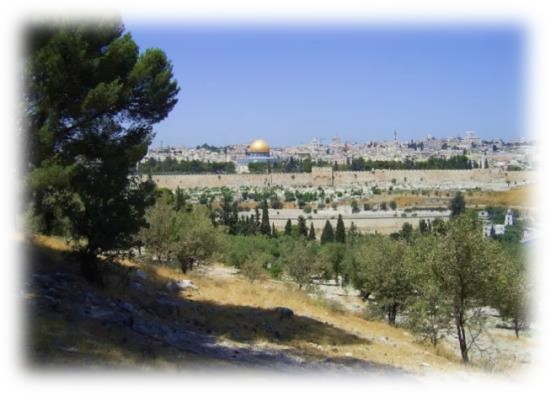
The Disciples walked up to Jesus and asked Him when the Temple was going to be destroyed. They also wanted to know what the sign would be that He was about to return, and that the world (as they knew it) was about to end. In His answer, the Lord laid out a list of events which He said must happen first:
- the coming of false Messiahs or Christs
- wars and rumours of wars
- conflicts between nations and different ethnic groups
- famines and earthquakes in various places
Sound familiar? At this point the Lord Jesus used a powerful illustration to help the Disciples understand what He was saying. He likened all these future events to “birth pains” that come upon a pregnant woman when she goes into labour. These pains don’t happen all at once, but they become more painful and more frequent until the birth. The Lord was saying that when these events start to happen, His followers would know that His return, and the end of the age, was near. He then mentioned other things that have to take place beforehand:
- “tribulation” for many Christians – hatred, persecution, and death
- the collapse of belief in God throughout society
- the breakdown of relationships in society
- the rise of false prophets
- ever-increasing deception
- increased lawlessness and wickedness
- the love of many growing cold
- the Gospel of the kingdom being preached throughout the world
In this way, then, the Lord Jesus was giving His followers a general outline of things to watch out for. These would act like signposts pointing to His return and the end of the age. But remember: We don’t read any signs like these being given by the Apostles whenever they write about the Rapture. Why? Because ...
- NOTHING has to happen before the Rapture. It can happen AT ANY MOMENT, even before you read the next page of this booklet. The Rapture is a “sign-less event.”
- LOTS OF THINGS have to happen before the Second Coming. The Lord Jesus cannot return to this Earth at any moment. In fact, as we will see later, He can’t return for at least another 7 years. As we have just seen, certain signs have to happen first.
- The Rapture and the Second Coming are NOT the same event, and won’t occur at the same time!
Crucially, the Lord didn’t give any dates as to when all these events will take place. This was in keeping with His consistent message that His followers must be watching and waiting for His return at all times. A few moments later on the Mount of Olives, all this was made very clear to the Disciples when He declared: “But concerning that day and hour no one knows, not even the angels of heaven, nor the Son, but the Father only ... Watch therefore, for you know neither the day nor the hour” (Matthew 24:36, 25:13).
|
One Bible commentary sums up what the Lord Jesus was saying that day on the Mount of Olives, and what He has been saying for the past two thousand years: “Do not waste your time guessing the time, because I could come at any time!” Edward E. Hindson & Daniel R. Mitchell, Zondervan King James Version Commentary: New Testament, 2010 |
The Daniel 9 Prophecy
But the Lord Jesus did make a very dramatic announcement on the Mount of Olives that day, which must have made the hairs on the back of the Disciples’ necks stand up. He hadn’t said anything yet about the Temple and the time of its destruction. In fact, He had spoken quite generally about the events that would take place before His return, without giving too much detail. But in verse 15 everything suddenly changed:
“So when you see the abomination of desolation spoken of by the prophet Daniel, standing in the holy place (let the reader understand), then let those who are in Judea flee to the mountains. Let the one who is on the housetop not go down to take what is in his house, and let the one who is in the field not turn back to take his cloak. And alas for women who are pregnant and for those who are nursing infants in those days! Pray that your flight may not be in winter or on a Sabbath. For then there will be great tribulation, such as has not been from the beginning of the world until now, no, and never will be. And if those days had not been cut short, no human being would be saved. But for the sake of the elect those days will be cut short.” (Matthew 24:15-22)
There is too much in Matthew 24 to look at in any detail, and I wouldn’t claim to understand it all perfectly myself. Many books have been written dealing with this prophecy, and there has been a lot of disagreement. But that shouldn’t worry us, or put us off from trying to understand what the Lord Jesus was saying on that occasion. This is one of the most important chapters in the whole Bible, so is it any wonder that Satan has tried his utmost to confuse God’s people, cause them to argue, and keep them in the dark? All I am trying to do here is highlight a few key points, which I believe will help us understand just one thing:
We could be raptured at any moment!
Don’t worry too much about trying to understand every last detail, and don’t give up (and turn to your phone) if it all feels a little too much. You might need to read over this a few times before the penny drops, but it will drop with the Lord’s help – and He will show you what He wants you to learn from all this. So, on we go! Ready? Good – I knew you’d say yes!
Notice a few more things from this incredible prophecy in Matthew 24:
- Firstly, do the words of the Lord Jesus in this prophecy sound anything like what the Apostles had to say about the Rapture? Remember the verses we looked at earlier, with all those strange Greek and Latin words like harpadzo and rapiemur? What the Lord Jesus prophesied on the Mount of Olives, and what the Apostles wrote in their letters, are very different things. They were not talking about the same event!
- In verse 15 of Matthew 24, the Lord refers to the prophet Daniel, an Old Testament prophet. The Lord was telling the Disciples that in order to understand what He was saying to them about the Temple and the “abomination of desolation,” they needed to understand what Daniel had prophesied 550 years earlier.
- The words “let the reader understand” were not spoken by the Lord Jesus. The Disciples were not sat reading something the Lord had written; they were sat listening to something He was saying there and then. The words “let the reader understand” were added by Matthew (the Gospel writer, not our pastor at Queensferry), to point every reader of his Gospel to the book of Daniel. We will turn there shortly.
- We have seen already that the Old Testament prophets knew nothing about the Church. They did not prophesy about the Church because the Church was a mystery kept hidden by God until the time of the Apostles. Remember, the Prophets prophesied about future events on Earth, events that would be connected to God’s earthly people, Israel. Therefore, when the Lord Jesus was pointing the Disciples back to Daniel, He was pointing them to events that will take place in the future THAT ARE NOT CONNECTED to God’s spiritual people, the Church. To put it simply,
1. The Church was not there in Daniel’s day!
2. The Church was not there in Jesus’ day!
3. The Church will not be there when this prophecy in Matthew 24 is fulfilled and the abomination of desolation is standing in the Temple!
4. The reason why the Church will not be there when this prophecy is fulfilled, is because the Church will have already been raptured!
Before we look at which prophecy, or prophecies, of Daniel the Lord Jesus had in mind, notice what He said about “the abomination of desolation.” First of all, He started with these words: “when you see”. Who did He mean? Who was going to actually see this terrible thing that would one day appear in the Temple? We know, of course, that the Lord was speaking to the Disciples on the Mount of Olives, but none of them ever saw this abomination! It isn’t clear how many of the Disciples were still alive when the Roman armies set fire to the Temple and destroyed it in the year AD 70 (by the way, AD = Anno Domini, which is a Latin phrase meaning “year of the Lord,” and so AD 70 means it was 70 years after the birth of the Lord Jesus. Today the year is AD 2024). But in the year AD 70, no such abomination was set up by the Romans when they destroyed Jerusalem. That’s because “the abomination of desolation” is still future, it hasn’t happened yet. So then, who did the Lord mean when He said “when you see”? Here are a few more clues:
- The Lord Jesus was sat on the Mount of Olives overlooking the Temple in Jerusalem. Jerusalem, which is the capital city of Israel, is located in a region known in the Bible as Judea (PLEASE NOTE: the nations of the world, which hate Israel because they hate God, call this region “the West Bank” – you may have heard this name on the news. It is one of Satan’s ways of mocking Israel and mocking God).
- In this prophecy, the Lord Jesus gave a specific warning to “those who are in Judea,” telling them to flee to the mountains and not to go down from the housetop or turn back from the field to get their cloaks. This clearly does not apply to the vast majority of believers living in the world today. When the Lord says, “Pray that your flight may not be in winter or on a Sabbath” (verse 20), why would any follower of the Lord Jesus be concerned about such a thing happening on a Sabbath day? Only those Jewish people who have rejected the Lord Jesus and remain in bondage to their own Sabbath laws and traditions would be in trouble here. One of their laws did not allow them to travel more than a short distance on the Sabbath; this would be a major problem if your only hope is to flee to the mountains! You and I, as believers, are free to travel any distance on any day of the week (as the Lord leads!)
Are you still with me? Keep going, take your time, put the kettle on, take a break, have a nap, smile, praise the Lord, and keep looking up all the verses in the Bible as we go along. Don’t stop asking the Lord to help you understand what He wants you to understand. Amen? Amen!
So, here is what we can say so far about those who will one day “see” this abomination of desolation standing in the Temple in Jerusalem:
- The whole background to this prophecy in Matthew 24 is Jewish. In other words, what our Lord was speaking about mainly concerns the Jewish people – those who will be living in Jerusalem when the abomination of desolation is set up in the rebuilt Temple.
- If you turn to Revelation 12 you will read another dramatic prophecy from the Lord Jesus, which is connected to Matthew 24. We read there how the “woman” (Israel) will flee from the “great red dragon” (Satan) into the wilderness, to be protected by God for 1,260 days (or 3 years – a year in Bible prophecy is 360 days). So, when the Lord was speaking about the “abomination of desolation” being set up in the Temple, He was talking about something that will be a direct work of Satan himself. It will be Satan’s final attempt, before Jesus returns, to blaspheme God and destroy Israel.
The Abomination of Desolation
We now need to know what this “abomination of desolation” is all about, since the Lord Jesus pinpointed it as the major event to look out for before His Second Coming. First of all, we need to know what the prophet Daniel said about it, since the Lord referred to Daniel in Matthew 24. Three times Daniel mentioned this “abomination of desolation” in his prophecies. Don’t worry about all the detail and background, just read the relevant part of these three prophecies below:
- “And he shall make a strong covenant with many for one week [7 years], and for half of the week [3 years] he shall put an end to sacrifice and offering. And on the wing of abominations shall come one who makes desolate, until the decreed end is poured out on the desolator.” (Daniel 9:27)
- “So he shall return and show regard for those who forsake the holy covenant. And forces shall be mustered by him, and they shall defile the sanctuary fortress; then they shall take away the daily sacrifices, and place there the abomination of desolation. Those who do wickedly against the covenant he shall corrupt with flattery; but the people who know their God shall be strong, and carry out great exploits.” (Daniel 11:30-32)
- “And from the time that the daily sacrifice is taken away, and the abomination of desolation is set up, there shall be one thousand two hundred and ninety days.” (Daniel 12:11)
Look at that second prophecy for a moment, because it will help us understand the other two. More importantly, it will help us understand what the Lord Jesus was saying to the Disciples on the Mount of Olives that day.
That second prophecy in Daniel 11 has already been fulfilled. It happened in the year 167 B.C. (where B.C. = “before Christ,” so 167 years before Jesus was born). Have you heard of the Jewish festival of Hanukkah? Here is a photo of a Jewish family celebrating this festival, which occurs every year in December. In John 10 we read about the Lord Jesus walking in the Temple courts during Winter, during the “Feast of Dedication.” Hanukkah comes from a Hebrew word meaning “to dedicate.” So, what is this festival all about?
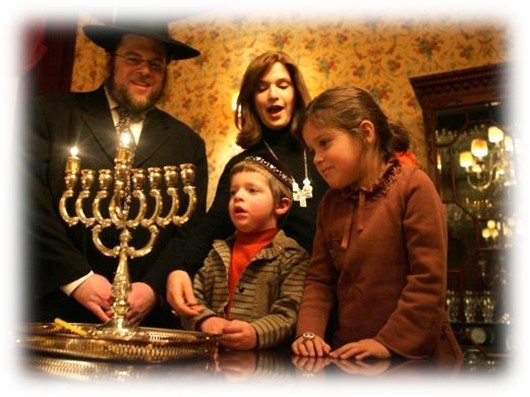
In the year 167 B.C., a Greek king by the name of Antiochus IV captured Jerusalem. Antiochus nicknamed himself “Epiphanes,” which means “God manifest” or “God in the flesh.” He desecrated the Temple by erecting a statue to the Greek god Zeus inside the holy of holies, and by sacrificing a pig (which is unclean to Jews) on the altar. This was an “abomination” that caused great “desolation” – in other words, it defiled the holy Temple and destroyed that which was so precious to the Jewish people. Antiochus also put an end to all Jewish sacrifices in the Temple, and did many other terrible things to the Jews.
Many rebellious Jews (“those who forsake the holy covenant” in the Daniel 11 prophecy) welcomed Antiochus and followed him. But the faithful Jews (“the people who know their God” in the Daniel 11 prophecy) resisted him, and many of them lost their lives. A group of Jewish fighters called the Maccabees ultimately rose up and defeated Antiochus, who died a horrible death after been struck down by God. The Maccabees cleansed the Temple of its “abomination,” and re-dedicated it to God. They then made a vow that each year they would celebrate God’s deliverance from the evil Antiochus. This annual celebration became known as “the Feast of Dedication,” or Hanukkah.
So, what does any of this have to do with the Rapture?
Keep going, we’re getting there (slowly, but surely!)
The fulfilment of the Daniel 11 prophecy in the days of Antiochus IV is connected to the other Daniel prophecies, and more importantly, to Matthew 24. It gives us a big clue as to what is going to happen in the future, at the time the Lord Jesus was talking about that day on the Mount of Olives. Antiochus was a man who thought he was a god. He conquered Jerusalem, defiled the Temple, stopped the Jewish sacrifices, and killed many Jewish people. He also failed! God judged him, he died, Israel and Jerusalem were liberated, the Temple was cleansed, and the Jewish people rejoiced. Now let’s read in more detail the Daniel 9 prophecy, which is THE KEY to everything we are talking about here! First of all, here is the part I quoted above:
“And he shall make a strong covenant with many for one week [7 years], and for half of the week [3 years] he shall put an end to sacrifice and offering. And on the wing of abominations shall come one who makes desolate, until the decreed end is poured out on the desolator.” (Daniel 9:27)
Question: Who was Daniel talking about? Who is the “he”? Who is this “desolator”?
Answer: The Antichrist!
Question: Who are the “many”?
Answer: In the first instance, they will be the unbelieving Jewish leaders in Israel!
Now let’s look at the Daniel 9 prophecy in full. Read through it slowly, maybe a couple of times, and let it sink in. It’s not an easy passage to follow, but it’s extremely important. I have put some things in square brackets [ ] to help you understand important names, titles, places, and times which the angel Gabriel spoke to Daniel about. One thing we need to know is that one “week” in Bible prophecy means 7 years, not 7 days. With that in mind, on we go.
The 70 “Weeks” of Daniel 9
“While I [Daniel] was speaking and praying, confessing my sin and the sin of my people Israel [not the Church!], and presenting my plea before the Lord my God for the holy hill of my God [Mount Zion in Jerusalem], while I was speaking in prayer, the man [angel] Gabriel, whom I had seen in the vision at the first, came to me in swift flight at the time of the evening sacrifice. He made me understand, speaking with me and saying, ”˜O Daniel, I have now come out to give you insight and understanding. At the beginning of your pleas for mercy a word [of prophecy] went out, and I have come to tell it to you, for you are greatly loved. Therefore consider the word and understand the vision:
Seventy weeks [1 week = 7 years, so 70 weeks = 70 x 7 years = 490 years] are decreed about your people [the Jews] and your holy city [Jerusalem], to finish the transgression, to put an end to sin, and to atone for iniquity, to bring in everlasting righteousness, to seal both vision and prophet, and to anoint a most holy place [the Millennial Temple in Jerusalem, which the Lord Jesus will enter when He returns].
Know therefore and understand that from the going out of the word to restore and build Jerusalem [given by King Artaxerxes in Nehemiah 2] to the coming of an anointed one, a prince [the Messiah Jesus], there shall be seven weeks [1 week = 7 years, so 7 weeks = 7 x 7 years = 49 years]. Then for sixty-two weeks [62 weeks = 62 x 7 years = 434 years] it shall be built again with squares and moat, but in a troubled time. And after the sixty-two weeks [after these 434 years + the 49 years that went before that = 483 years in total], an anointed one [the Lord Jesus] shall be cut off [crucified] and shall have nothing.
And the people [the Roman armies] of the prince who is to come [the Antichrist] shall destroy the city [Jerusalem] and the sanctuary [the Temple that was in Jerusalem when the Lord Jesus was there]. Its end [the destruction of the Temple in AD 70] shall come with a flood, and to the end there shall be war. Desolations are decreed. And he [the Antichrist] shall make a strong covenant with many for one week [7 years], and for half of the week [3½ years] he shall put an end to sacrifice and offering. And on the wing of abominations shall come one who makes desolate, until the decreed end is poured out on the desolator [the Antichrist].’” (Daniel 9:20-27)
Phew! Did you follow it all? I knew you’d say that!
It’s not easy is it, especially with all the maths in there? But God gave us (and not just Daniel) all of this information, including the numbers of weeks, so that we would understand what is going to happen in the future. Maybe try reading it through once more – go on, have a go – but this time read it s-l-o-w-l-y.
I cannot stress enough just how critically important this prophecy is! Without going in too deep here, there are a few things which we can definitely say about what we’ve just read:
- Daniel was a Jewish man living in exile in Babylon (which is in modern-day Iraq).
- Daniel was confessing his own sin and the sin of his people, the Jewish people. Israel’s persistent sin is the reason why God exiled them to Babylon.
- Daniel prayed for Jerusalem and the Temple, which were in ruins.
- Daniel knew God had set a limit of 70 years for the exile (see Jeremiah 25:11-12). He also knew that the 70 years were coming to an end, which is why he was praying.
- Seventy weeks (70 × 7 years = 490 years) were decreed by God “about your people and your holy city”.
Who were Daniel’s people? --> The Jewish people
Which was Daniel’s holy city? --> Jerusalem - This means, then, that everything in Daniel’s prophecy has to do with the Jewish people, and the city of Jerusalem, and the holy Temple. It has nothing to do with the Church, which didn’t exist until 600 years after this prophecy was given. This is a key part of God’s prophetic calendar for the nation of Israel.
So, when a prophecy is given about a particular person, people, city, or nation, it CANNOT BE FULFILLED by someone else, or somewhere else! This prophecy was given to Israel, so we cannot insert the Church into any part of it. (It will become clear later why this is very important.) - Daniel’s prophecy includes the First Coming of the Messiah, the Lord Jesus. God told Daniel, through the angel Gabriel, that there would be 69 “weeks” from the time the decree to rebuild Jerusalem was given, to the crucifixion (or “cutting off”) of Messiah.
Are you ready for more Maths?
Don’t worry, you don’t need to be good at Maths to understand God’s Word (or enter Heaven!) Just do your best and try and follow it through, nice and slow. If you can’t follow it, DON’T WORRY – not a problem! The Lord didn’t call us to be good at Maths, He called us to love, honour, and obey Him, and to love one another (including me, the one giving you a headache right now). Ok then, here we go:
- The “word to restore and build Jerusalem” (which we read in Daniel’s prophecy) was given in Nehemiah’s day in the year 445 B.C. (445 years Before Christ). We read about this word, or decree, in Nehemiah chapter 2. Take a look for yourself.
- Now it gets a little more complicated. But remember this: God has given us many numbers in His Word, which means they are very important.
- You and I live each day according to a particular calendar. A calendar is simply a way of organizing our lives into days, weeks, months, and years. Our calendar is based on one week being 7 days, and one year being 52 weeks or 365 days (366 days in a leap year). Our years are called “solar years,” because they are based on the time it takes for the earth to orbit, or go round, the sun (solar just means ”˜relating to the sun’). All we need to know here, is that when we are reading Bible prophecy about the end-times, 1 year = 360 days, not 365 days.
- You can see this for yourself if you look up Revelation 11:2-3 and Revelation 12:6. Here are those verses in the English Standard Version (ESV), but why not look them up in your own Bible and “do the math” (as the Americans say):
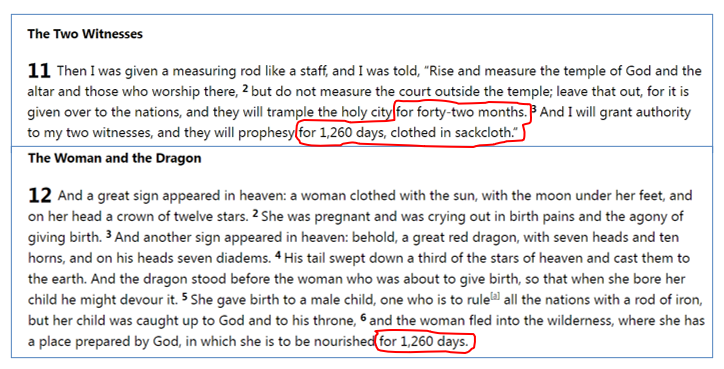
- So, in the above verses we learn that
|
42 months is the same as 1260 days which means 1 month = 30 days (1260 ÷ 42) |
- When you take 483 of these b>prophetic 360-day years (which is the total number of years in the first 69 “weeks” of Daniel’s prophecy) and add them to the year 445 B.C. (445 years Before Christ, when the decree was given to Nehemiah), what year do you come to? Got it? Not sure? Well, I’ll tell you then:
It’s the year our Lord Jesus Christ was crucified!
- Now can you see why the numbers are important? And is it any wonder that Jewish rabbis do not mention the Daniel 9 prophecy to their own people! They are deaf and blind guides, just like the scribes and Pharisees of old (Isaiah 42:18-19; Matthew 23:13-36). Who else in the history of the world, and in the history of Israel, could Daniel’s prophecy be referring to? An anointed prince, a Messiah, who would be “cut off” (killed) 483 years after the decree to rebuild Jerusalem in 445 BC. Daniel’s prophecy proves so very clearly that:
Jesus is the promised Messiah!
Any of you thinking, “So, what has all this got to do with the Rapture?” Keep going, we’ll get there! Remember, we are called to give a reason for why we believe what we believe (1 Peter 3:15), and I hope and pray that this will help deepen our understanding of the doctrine of the Rapture, and help us to graciously answer any brother or sister who may disagree with us (or who may simply not understand). In the end, I hope and pray that it will encourage you in what you already know to be true, or thought was probably true but didn’t fully know why – that our Lord Jesus is going to catch us away ANY DAY to the Father’s house!
Right then, so where are we up to after all this head-aching Mathematics? Please don’t worry (or switch on your phone) if I have lost you here. It’s not vitally important that you follow all the maths, just KEEP GOING!
We have reached the end of the first 69 “weeks” (or 483 years) of Daniel’s 70-week prophecy about his people (the Jews) and his holy city (Jerusalem) – nothing to do with the Church remember. As we have just noted, those first 69 weeks ended when the Lord Jesus was crucified. But that was 2,000 years ago, and today Israel is still in rebellion against God. Many Jews have become believers, but Israel as a nation still rejects her Messiah. Not only that, but the holy city Jerusalem, which our Lord called “the city of the great King” (Matthew 5:35; Psalm 48:2), is as corrupt and as sinful as most other cities on earth. But remember:
Daniel’s prophecy was about 70 “weeks,” not 69 (70 × 7 years = 490 years)
And we know that all these years were decreed for God to deal with Israel (not the Church). The question now is: what about the last week, the 70th week, the final 7 years of the prophecy? The answer is, it hasn’t happened yet! This means that the whole of Daniel’s prophecy hasn’t been fulfilled yet! And this means that God hasn’t finished dealing with Israel yet! There are still 7 years of that prophecy to come – the 70th week of Daniel.
|
These final 7 years are known as The Tribulation. These 7 years are all to do with God’s judgment or wrath. These 7 years are all to do with Israel (and the nations). These 7 years will reach their climax in Jerusalem. These 7 years have nothing to do with the Church! These 7 years have nothing to do with Life & Light Missions!
These 7 years have nothing to do with [ Insert your name here ] |
Notice what Gabriel told Daniel was going to happen i>after the 69th week, which ended when the Lord Jesus was crucified. Daniel was told that “the people of the prince who is to come shall destroy the city and the sanctuary. Its end shall come with a flood, and to the end there shall be war. Desolations are decreed.” This happened in the year AD 70, when Jerusalem (“the city”) was taken by the Roman armies (“the people”), and when the Temple (“the sanctuary”) was destroyed. This is what the Lord was referring to in Matthew 24:2, when He spoke about all the stones of the Temple being “thrown down”. You can see some of those stones today if you visit Jerusalem. Here is a photograph I took a few years ago:
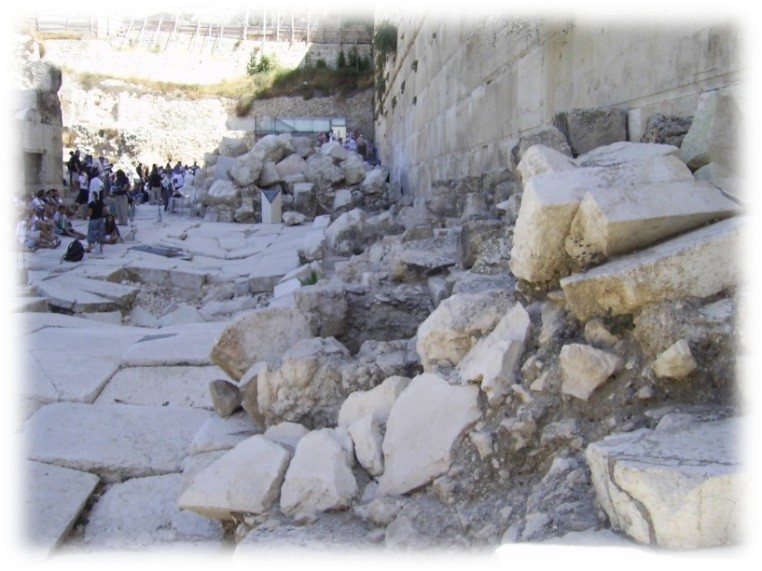
So, from this part of Daniel’s prophecy we now know ...
- who “the people” were who did the destroying – the Romans
- which “city” and “sanctuary” were destroyed – Jerusalem and the Temple
- when all this happened – AD 70, just forty years after the Lord Jesus spoke to the Disciples about it in Matthew 24
One more question remains: who did the angel Gabriel have in mind when he spoke about “the prince who is to come”? Which prince? Has he been yet, or is he still to come? I gave the answer in the square brackets [ ] above when I quoted the Daniel 9 prophecy in full. Now we’ll see why it will be who I said it will be.
The Dark Prince
Verse 27 of Daniel 9 makes it very clear that this prince has not yet come, but that his coming is to do with the 70th week of Daniel’s prophecy. This prince is related to the people (the Romans, or Roman Empire) who destroyed Jerusalem and the Temple in AD 70. But this prince did not come at that time – he wasn’t the Roman general Titus who commanded the Roman armies when Jerusalem fell. We are told that when this prince comes he is going to confirm a strong covenant “with many,” or “with the many,” for one week (7 years). The “many” here is a reference firstly to Israel, and then maybe to other nations as well. This covenant is what will trigger, or set off, the Tribulation, which will end 7 years later at the Second Coming.
We are told that half-way through the 7-year Tribulation this prince will put an end to sacrifices and offerings, and set up some kind of abomination that brings desolation. If he is to put an end to sacrifices and offerings, then it means that the Temple in Jerusalem must have been rebuilt already, because the Jewish people cannot make sacrifices without it – they haven’t been able to do so since it was destroyed in AD 70. I know I’m stating the obvious here, but there is no Temple in Jerusalem right now! Therefore it has to be rebuilt at some point in the (near) future. So, this prince is going to be a man so evil that he will commit the ultimate blasphemy, by setting up an abomination in the holy place of the Temple. Remember when we looked at the Jewish festival of Hanukkah, and what Antiochus “Epiphanes” did in the Temple all those centuries ago?
Still with me? Good! Now read again what the Lord Jesus said to His disciples on the Mount of Olives:
“So when you see the abomination of desolation spoken of by the prophet Daniel, standing in the holy place (let the reader understand), then let those who are in Judea flee to the mountains.” (Matthew 24:15)
And now read what the Apostle Paul later wrote, in his second letter to the Thessalonians:
“For that day will not come, unless the rebellion comes first, and the man of lawlessness is revealed, the son of destruction, who opposes and exalts himself against every so-called god or object of worship, so that he takes his seat in the temple of God, proclaiming himself to be God.” (2 Thessalonians 2:3-4)
“And then the lawless one will be revealed, whom the Lord Jesus will kill with the breath of His mouth and bring to nothing by the appearance of His coming.” (2 Thessalonians 2:8)
And now read what the Apostle John wrote many years later, in the book of Revelation:
“Then I saw heaven opened, and behold, a white horse! The one sitting on it is called Faithful and True, and in righteousness He judges and makes war ... And the beast was captured, and with it the false prophet who in its presence had done the signs by which he deceived those who had received the mark of the beast and those who worshiped its image. These two were thrown alive into the lake of fire that burns with sulphur.” (Revelation 19:11,20)
And now let’s try and put all the pieces together.
The “prince who is to come” is the same person as “the man of lawlessness,” “the lawless one,” “the son of destruction,” and “the beast.” We are told that he will exalt himself in the Temple in Jerusalem, where he will seek to proclaim himself as God. Who is he? Who is coming to commit this ultimate blasphemy? The Antichrist!
The same location where God once commanded Israel to worship Him – the very place where God told Solomon that His Name, His eyes, and His heart would always be there (1 Kings 9:3) – is where the Antichrist, on Satan’s behalf, will seek to be worshipped. But please understand something here. The Temple that is going to be rebuilt in Jerusalem, the one that will be standing during the Tribulation which the Antichrist will enter, will not be a Temple ordained by God! This Temple is going to be built by unbelieving Jews who are in rebellion against God – it will not have His blessing! Many Christians have been getting carried away every time they hear news that preparations are being made by the Jewish people for the Temple to be rebuilt in Jerusalem. Yes, we can get excited that Bible prophecy is being fulfilled, but we must not get excited by something which God is going to allow to happen, which will not have His blessing, and which will be used for evil purposes and not for good!
Antichrist’s entrance into the Temple will be the ultimate blasphemy, the ultimate abomination of desolation – and this is what the Lord Jesus was warning about on the Mount of Olives in Matthew 24. Please remember, this is all going to happen half-way through the 70th week of Daniel’s prophecy; in other words, 3½ years into the Tribulation period. The Lord was therefore making a hugely important and very dramatic statement, because He was pinpointing the exact time in the future when “the abomination of desolation spoken of by the prophet Daniel” will be seen in the Temple. See if this little chart helps:
|
The 7-year Tribulation or The 70th week of Daniel’s prophecy
|
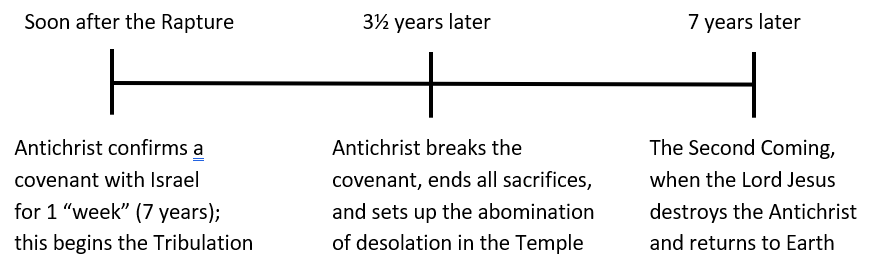
So, everything we have been saying here is all connected with the 70-week prophecy of Daniel, and especially the 70th week, which is the time of the Tribulation. Always keep in mind what was said earlier, that Daniel’s prophecy is all to do with Daniel’s people (the Jews) and Daniel’s holy city (Jerusalem). It had nothing to do with the Disciples who were with the Lord Jesus that day on the Mount of Olives, and it has nothing to do with the Church (and that includes you, me, and everyone who belongs to Light & Life Missions in Queensferry and beyond!) To put it simply, we won’t be here when these horrific things begin to happen!
Not Destined for Wrath!
The Tribulation period is all about Divine judgment, or wrath, being poured out upon an unbelieving world that has rejected its Creator, God, and Saviour. We have already looked at some of the terrible things that are going to happen during these final 7 years before the Second Coming of our Lord Jesus Christ. There is nothing encouraging or comforting at all in these Tribulation verses; it is going to be the darkest time in the history of planet Earth. But as we saw earlier, no such things were ever written by the Apostles when they were writing to believers about “that Day” – the Day when we will be caught up to meet the Lord in the air and taken to the Father’s house!
The Tribulation period is also the time when God will complete His punishment of Israel, restore a remnant of His chosen people to Himself, and make Israel the chief nation on Earth. Can any of us possibly imagine a time more terrible than the Holocaust, when at least 6 million Jews (including 1.5 million Jewish children) were murdered by Adolph Hitler and the Nazis? But Hitler wasn’t the Antichrist! The world has yet to see “the man of lawlessness,” who will rule with all of Satan’s power and authority (which Hitler didn’t have). The Antichrist will be more terrifying than a thousand Hitlers, even though when he first appears he will deceive the world into believing that he is its Saviour, a man of peace. Let’s now turn back to Matthew 24 and continue reading what the Lord said to the Disciples on the Mount of Olives.
After warning about “the abomination of desolation spoken by the prophet Daniel” (Matthew 24:15), the Lord Jesus said this:
“For then there will be great tribulation, such as has not been from the beginning of the world until now, no, and never will be. And if those days had not been cut short, no human being would be saved. But for the sake of the elect those days will be cut short.” (Matthew 24:21-22)
The Lord Jesus was speaking about the second half of the Tribulation – those final 3½ years after the Antichrist breaks covenant with Israel, and sets up the abomination of desolation in the Temple. The Lord declared that this time will be like no other in the history of the world, and that if God hadn’t limited its length, then no human being would survive. He was clearly not talking about the Holocaust, but about something even worse – the time of God’s wrath, which will include the time when the Antichrist will be revealed. The Lord Jesus was quoting here from Daniel 12:1, which reads as follows:
“And there shall be b>a time of trouble [the Tribulation], such as never has been since there was a nation till that time. But at that time your people [Israel] shall be delivered, everyone whose name shall be found written in the book.”
The prophet Jeremiah also prophesied about the Tribulation period. He made it very clear that this horrific time will all be about God’s dealings with Israel (and not the Church!) Here is how Jeremiah’s prophecy begins:
“Now these are the words that the Lord spoke concerning Israel and Judah. ”˜For thus says the Lord: “We have heard a voice of trembling, of fear, and not of peace. Ask now, and see, whether a man is ever in labour with child? So why do I see every man with his hands on his loins like a woman in labour, and all faces turned pale? Alas! For that day is great, so that none is like it; and it is the time of Jacob’s trouble, but he shall be saved out of it.” (Jeremiah 30:4-7)
Please note the glorious promise at the end there, that “Jacob” (a personal name which God uses a lot in the Bible for Israel) will be saved out of the Tribulation. We must always remember that whenever God disciplines His own people (whether that’s Israel or the Church), it is only for a time, and always with a view to restoration. In Israel’s case, this time will be the worst there has ever been in the history of the world – but Israel will survive! Israel must go through the Tribulation, because it’s the only way a remnant of the nation will turn to Jesus to be rescued and restored. When the Prophet Jeremiah says that “Jacob” (Israel) will be saved “out of it,” it doesn’t mean that unbelieving Jews won’t go through it, but that many of them will be saved during it. We have an early prophecy of this in the book of Deuteronomy, before the Israelites entered the Promised Land. As Moses prophesied,
“When you [Israel] are in tribulation, and all these things come upon you in the latter days, you will return to the Lord your God and obey His voice. For the Lord your God is a merciful God. He will not leave you or destroy you or forget the covenant with your fathers that He swore to them.” (Deuteronomy 4:30-31)
Hallelujah!
Kept from the Hour!
So remember, we are still looking here at the reasons why you and I (and everyone who belongs to the true Church of Jesus Christ) will not and cannot go through this 7-year Tribulation period. We will be raptured before it begins. Having just looked at Jeremiah’s prophecy about Israel, let us now consider, for a moment, a few verses in the book of Revelation which do concern us as believers:
“Because you have kept my word about patient endurance, I will keep you from the hour of trial that is coming on the whole world, to try those who dwell on the earth.” (Revelation 3:10)
These words were spoken by the risen and ascended Lord Jesus to the church in Philadelphia (a town now called Alaşehir in modern-day Turkey). This church, unlike five of the other seven churches which the Lord spoke to, received nothing but praise and encouragement. By the way, “Philadelphia” means brotherly love, and the believers certainly lived up to that name! They had little strength and suffered terrible persecution, but they remained faithful, obeying God’s Word, honouring His Son, and loving one another. This was a church which the Lord loved dearly, and He gave them an incredible promise – that they would be kept from “the hour of trial.” Now notice what the Lord said about this “hour of trial” – it would come upon the whole world, and it would try, or test, everyone in the world.
Question: When did the whole world ever face such an hour of trial?
Answer: Never! This is future.
|
This “hour of trial” = The 7-year Tribulation |
When the Apostle John heard the Lord Jesus speak these words to the church in Philadelphia, a widespread persecution of Christians was taking place under the Roman Emperor Domitian. That’s how John ended up on the island of Patmos in the first place, where he received the Revelation from the Lord Jesus. Before then, another terrible persecution of Christians had taken place during the reign of Emperor Nero; he was the emperor who had the Apostle Paul executed, and who fed Christians to the lions and used their bodies as human torches for his garden parties! But for all that evil, the Roman Empire did not control the whole world at that time. In fact, there was widespread peace and prosperity throughout the Empire for 200 years (historians call this the “Pax Romana,” which means “Roman Peace”). So then, these persecutions of Christians were local to certain areas within the Empire, but they were not global, covering the whole earth.
Notice a few more important things from the Lord’s letter to the church in Philadelphia:
- The Lord Jesus praised this church because they had already endured great suffering and persecution – “you have kept my word about patient endurance”. In other words, the Lord wasn’t preparing them for persecution in the future, He was applauding them for having faced it in the past!
- When the Lord referred to “the hour of trial,” He said it would be a time that would “try” or “test” those who dwell upon the Earth. The Greek word for “try” or “test” means to show, or prove, what’s inside so that all can see. In this case, it will be the people on Earth who will be put through a time of trial and testing to show clearly what’s inside them, what they’re made of. Here are a few thoughts to help us:
- We know that this is what happens to us as believers whenever we go through trials of various kinds in our lives. These trials are designed by God to test us in a way that will purify and strengthen us, and show others that our faith is real and rooted in Him. The Apostle Peter uses the same word when he writes: “Beloved, do not be surprised at the fiery trial when it comes upon you to test you, as though something strange were happening to you” (1 Peter 4:12). These trials are common to all of us as Christians – trials of family, marriage, health, work, money, ministry etc. If we trust God and submit to these trials, even counting it “all joy” as we do so, then our hearts will be purified, our faith strengthened, and we will come through looking more like Jesus (1 Peter 1:6-7; James 1:2-4).
But these kinds of trials are NOT what the Lord had in mind when He spoke about “the hour of trial” coming upon the whole Earth!
- Remember who this hour of trial is for – it is for those who will be dwelling on the Earth when it happens. Right now, you and I dwell on the Earth, but our true and final home is with the Lord Jesus. As the Apostle Paul writes, “our citizenship is in Heaven” (Philippians 3:20). So, when the Lord speaks about the “hour of trial” coming upon “those who dwell on the Earth,” He is NOT talking about the Christians in Philadelphia back then, or the Christians in Queensferry right now, or any Christians who have lived during the past 2,000 years.
The phrase “those who dwell on the earth” appears 11 times in the book of Revelation. It is always used to describe unbelievers who have persistently rebelled against God, rejected His Son, and disqualified themselves from Heaven. In fact, they don’t just reject God, they hate God! In Revelation 13:8 we read: “All who dwell on the earth will worship him [the Beast/the Antichrist], whose names have not been written in the Book of Life of the Lamb slain from the foundation of the world.” - So then, this “hour of trial” is for these rebellious unbelievers, and only them. It isn’t designed by God to see if they will pass the test and turn to Him and be saved, but to show what they’re truly made of – pride, arrogance, rebellion, hatred, treachery, evil thoughts etc. It will also vindicate God by showing that He is absolutely just in pouring out His wrath upon them during the Tribulation period – no matter how much He loves them, and no matter how many opportunities He gives them to repent, they never will.
In His letter to the believers in Philadelphia, the Lord Jesus promised that they would be “kept from” this “hour of trial” that is coming upon the whole world. In other words, they wouldn’t have to go through any part of it, because it wasn’t for them! The word “hour” in this verse, like in many other verses of the Bible, doesn’t mean 60 minutes, but a period or season of time when certain things are to happen. But was the Lord Jesus only speaking to the church in Philadelphia? Why would He make this promise only to them, when nearly 2,000 years later this “hour of trial” (the Tribulation) still hasn’t happened? I believe it’s because this promise was given by the Lord Jesus to all true believers, to all who keep His Word and do not deny His Name, like the Philadelphians. Trials will come to all of us, that’s for certain, but this hour of trial is something very different. We will face many tribulations in our lives, as we said earlier, but the Tribulation/the Great Tribulation is unique, a special time in the sovereign purposes of God – it is not for those who love Him, who are His children and the Bride of His Son, but for those who hate Him and reject His Son!
|
Therefore we will not, and we can not, go through ...
This time of God’s judgment and wrath is not for the Church! |
Question: What did the Apostle Paul say about God’s wrath in His letters?
Answer: He said that we are not destined to face God’s wrath, because of what the Lord Jesus did for us on the Cross!
- “For they themselves report ... how you turned to God from idols to serve the living and true God, and to wait for His Son from heaven, whom He raised from the dead, Jesus who delivers us from the wrath to come.” (1 Thessalonians 1:9-10)
- “For God has not destined us for wrath, but to obtain salvation through our Lord Jesus Christ, who died for us so that whether we are awake or asleep we might live with Him.” (1 Thessalonians 5:9-10)
- “Since, therefore, we have now been justified by his blood, much more shall we be saved by Him from the wrath of God.” (Romans 5:9)
- “And you were dead in the trespasses and sins in which you once walked ... and were by nature children of wrath, like the rest of mankind. But God, being rich in mercy ... made us alive together with Christ – by grace you have been saved” (Ephesians 2:1-6).
- “Let no one deceive you with empty words, for because of these things the wrath of God comes upon the sons of disobedience.” (Ephesians 5:6; Colossians 3:6)
TThe Tribulation period is the time when God’s wrath is going to be poured out upon the people of the Earth, upon those who will be left behind after the Rapture. It will reach its climax on the day of the Second Coming, when the Lord Jesus returns to judge the nations. The whole of the Tribulation period is the time of God’s wrath, although it will intensify half-way through. This second half, or final 3½ years (42 months or 1260 days), is known as The Great Tribulation (Revelation 7:14). Sadly, there are well-known preachers and teachers in the Church today who divide the Tribulation into a time of Satan’s wrath (which they say the Church must face) followed by a time of God’s wrath (which they say the Church will not face). But this is NOT what the Bible teaches!
This kind of teaching, which says that we must pass through at least part of the Tribulation, has confused, troubled, and frightened many of God’s people. Most of all, I believe it dishonours God by giving Satan far too much authority, and far too much of a role in the end-times. We know, of course, that Satan will indeed be full of wrath during this time, because he knows his end is near (Revelation 12:12). However, what Satan will do on the Earth at that time is still part of God’s wrath being poured out upon those who dwell upon the Earth. The Lord Jesus, the Lamb of God, will be the One who finally brings the wrath of God and the 7-year Tribulation period to an end. As we read in the book of Revelation,
- “I saw another sign in heaven, great and amazing, seven angels with seven plagues, which are the last, for with them the wrath of God is finished.” (Revelation 15:1)
- “Then I heard a loud voice from the temple telling the seven angels, “Go and pour out on the earth the seven bowls of the wrath of God.” (Revelation 16:1)
- “From His mouth comes a sharp sword with which to strike down the nations, and He will rule them with a rod of iron. He will tread the winepress of the fury of the wrath of God the Almighty.” (Revelation 19:15)
- “Then the kings of the earth and the great ones and the generals and the rich and the powerful, and everyone, slave and free, hid themselves in the caves and among the rocks of the mountains, calling to the mountains and rocks, ”˜Fall on us and hide us from the face of Him who is seated on the throne, and from the wrath of the Lamb, for the great day of their wrath has come, and who can stand?’” (Revelation 6:15-17)
Who are these People?
When I think of my own family right now, I realise that the clock is ticking. Time is running out for them, because they don’t know Jesus as their Lord and Saviour. I know that at ANY MOMENT in ANY DAY of ANY WEEK, MONTH, or YEAR, the Lord Jesus will come and rapture you and I to Heaven. If that were to happen right now, then my family would be left behind to go through the Tribulation. This is why every day, since the moment I was born again in February 1990, I have prayed for their salvation. I know that God loves them so much more than I ever could or ever will, and that gives me great comfort and peace. I have faith that they will be saved, I just don’t know how or when it will happen. But I also get a lot of comfort and peace whenever I think of some amazing verses in Revelation 7. Let’s look at them for a moment, and hopefully they will encourage and comfort you just as much.
During the terrible time of Tribulation, something truly wonderful is going to happen. Remember, God is “not wishing that any should perish, but that all should reach repentance” (2 Peter 3:9; see John 3:16-17; 1 Timothy 2:1-4; 1 John 2:2). For centuries there has been false teaching in the Church which says that God has pre-determined (or predestined) who will be saved and who won’t be, who will go to Heaven and who will go to Hell and the Lake of Fire – and that no man or woman has any choice in the matter.
This false teaching insists that it was all settled by God in His infinite wisdom before the world began, so who are we to argue! Well, in my opinion and that of millions of other believers, we should argue, because this teaching is blasphemous. This is not the God we love and worship and read about all the way through Scripture, from Genesis to Revelation. God’s Word tells us plain and clear that every human being can be saved because of what the Lord Jesus did for all mankind on the Cross. But it also tells me that not every human being will be saved. So, with that hopefully settled in our minds, on we go with those verses in Revelation:
“After this I looked, and behold, a great multitude that no one could number, from every nation, from all tribes and peoples and languages, standing before the throne and before the Lamb, clothed in white robes, with palm branches in their hands, and crying out with a loud voice, ‘Salvation belongs to our God who sits on the throne, and to the Lamb!’” (Revelation 7:9-10)
Isn’t it wonderful that there is going to be a truly great, world-wide revival on Earth during the Tribulation period? Amazing grace, all glory to God! A huge number of people are going to be saved AFTER the Rapture and DURING the Tribulation. Will that number include some of our loved ones? I hope and pray that they will be saved before then so that they can be with us in the Rapture, but the reality is that the loved ones of many believers are going to be saved after we are gone. But something else happens in Revelation 7 as soon as John is shown this great multitude of saved sinners. I believe that what happens next is very important, because it gives us further proof that the Church will be raptured BEFORE the Tribulation begins. Here is verse 12:
“Then one of the elders addressed me, saying, ‘Who are these, clothed in white robes, and from where have they come?’ I said to him, ‘Sir, you know.’ And he said to me, ‘These are the ones coming out of the Great Tribulation. They have washed their robes and made them white in the blood of the Lamb.’” (Revelation 7:13-14)
What a conversation! Remember, the Apostle John was the leading (and perhaps only-surviving) Apostle in the Church at that time. He held pastoral authority over the churches we read about in Revelation 2 and 3. These were located in Asia Minor (part of modern-day Turkey). Yet he did not know who these redeemed saints were who he saw coming out of the Great Tribulation! If this multitude represented the Church, then surely John would have recognised them. If he had, then we would have to confess right now that the Church is going to be there in the Tribulation. But John didn’t recognise them! He had to be told who they were! Why? Because they were not the Church!
This multitude of saved people are going to be a special group of believers who will not be members of the Church. We might call this special group “tribulation saints” – sinners who will be saved after the Rapture and during the Tribulation. They won’t be part of the Church as we have known it for the past 2,000 years, because the Church will have been removed from the Earth by the Lord Jesus. However, they will still be as much the people of God as we are today, having been born again in exactly the same way as we were. At the Second Coming, we who will have been raptured approximately seven-years earlier will return to the Earth with the Lord Jesus. At that point we will be united, in some amazing way, with these tribulation saints.
Where has the Church gone?
Another important reason why the Church will not be here during any part of the 7-year Tribulation, is the fact that the Church isn’t mentioned from Revelation 4 all the way through to the end of chapter 18. In fact, the word “church” is only mentioned in 2 of the 22 chapters of Revelation, and only once after chapter 3. That’s quite amazing, especially when we think that these were the last words of the Lord Jesus and the final words of the Bible – and they were given to the Apostle John to give to the Church! It’s only when we come to the Marriage Supper of the Lamb in chapter 19, where we read about “the Bride” having “made herself ready,” that the Church comes into focus once more. So, why isn’t the Church there in all those chapters of Revelation, which deal with the events of the Tribulation? Simply because the Church isn’t there! John was being shown all that is going to happen AFTER the Church has gone, AFTER the Rapture has taken place!
But think about this as well, brothers and sisters. If the Church (including you and I) had been destined to go through the Tribulation – a time which, as we have already seen, will be like no other in the history of the world – then surely the Lord Jesus would have said something about it to His Church, His beloved Bride. And wouldn’t we expect the Apostles to have warned us about the Tribulation, and told us what to do when the Antichrist appears and all the judgments of God are being poured out upon the Earth? But such a warning is simply not there, because we will not be there when all this happens!
I now want to highlight three huge mistakes (and there are more than three by the way) that many Christian preachers, teachers, and writers have made, who claim that the Church must go through at least part of the Tribulation:
1. They point to three verses in Revelation 13 and 14, in which “the saints” are mentioned in the Tribulation. Here are those verses:
- “Also it [the Beast/the Antichrist] was allowed to make war on the saints and to conquer them.” (Revelation 13:7)
- “If anyone is to be taken captive, to captivity he goes; if anyone is to be slain with the sword, with the sword must he be slain. Here is a call for the endurance and faith of the saints.” (Revelation 13:10)
- “Here is a call for the endurance of the saints, those who keep the commandments of God and their faith in Jesus.” (Revelation 14:12)
So, then, who are these “saints”? Are they Christians like us, members of the Church? If they are, then the Church is clearly going to go through at least part of the Tribulation. And we know that the word “saints” is used a lot in the New Testament to refer to faithful followers of the Lord Jesus. For example, the Apostle Paul begins one of his letters this way: “To the church of God that is in Corinth, to those sanctified in Christ Jesus, called to be saints together with all those who in every place call upon the name of our Lord Jesus Christ” (1 Corinthians 1:2). However, we also read how “many bodies of the saints who had fallen asleep were raised” and came out of their tombs after the death and resurrection of the Lord Jesus (Matthew 27:52). These saints were not members of the Church, because the Church did not exist when that happened. The word “saints” is also used over 30 times in the Old Testament, mainly in the book of Psalms and mostly referring to faithful Israelites who loved and obeyed God. We read, for example, how God “raised up a horn for His people, praise for all His saints, for the people of Israel who are near to Him” (Psalm 148:14). The word “saints” is also used once to refer to angels (Deuteronomy 33:2; see Galatians 3:19).
So we see that just because a word may be used many times in the Bible, it doesn’t mean it has the same meaning every time! In each case we need to know the context, or background, in which it appears in order to understand its meaning. We have seen that the word “saint” or “saints” can refer to angels, to faithful Israelites in the Old Testament, to Jewish believers in the New Testament who died before the Church was formed, or to Jews and Gentiles who belonged to the Church then, and who have belonged to the Church ever since. This means that when we come to those verses in Revelation 13 & 14 that speak of “saints” in the Tribulation, we have to pull together everything we have looked at already concerning this period. When we do that, we see very clearly that these saints are not the same as the other saints; they are “tribulation saints,” a multitude of sinners who will be saved AFTER the Rapture, DURING the Tribulation, and BEFORE the Second Coming of Jesus.
2. There are many in the Church who insist that we must go through the Tribulation in order to be purified and prepared for the Lord Jesus. This is rank heresy! These men have simply created a Protestant form of purgatory. Purgatory is the place and process, according to the false Roman Catholic Church, where the souls of those who belonged to the Roman Catholic Church in this life will be punished and purged before entering Heaven. Is there any truth to this teaching? None whatsoever, it is error of the highest order, a lie from the pit of Hell! The Bible teaches very clearly that only by God’s grace, through faith in His beloved Son (not Mary or the saints or the Catholic Church) can a sinner be made right with God and ready for Heaven. We have peace with God NOW because of the Lord Jesus – because of His sinless life, His atoning death, and His glorious resurrection. All who have repented of their sins and turned to the Saviour are assured of God’s forgiveness and acceptance NOW, a relationship with the Lord Jesus NOW, and a place in Heaven THEN. It is utterly shameful (and dishonouring to the Lord) for any true believer to teach that we still have to be purged during the Tribulation in order to prepare us for Heaven. That means, brothers and sisters, that the Cross was not enough!
Not only that, but why should believers at the end of the Church age – at the end of time as we have known it – have to go through a special time of testing and purifying that believers for the past 2,000 years have not had to go through? We are called right now to be pure and holy, while we wait for the Lord to come and take us Home. And we do so only in response to what the Lord Jesus has already done for us, not to gain entrance into Heaven. It is this sinful world, including rebellious Israel, which must be cleansed and purged in readiness for the reign of the Lord Jesus with His Bride!
Let us remind ourselves of what the Apostles Paul, Peter, and John all wrote in their letters:
- “The night is far gone; the day is at hand. So then let us cast off the works of darkness and put on the armour of light.” (Romans 13:12)
- “Since all these things are thus to be dissolved, what sort of people ought you to be in lives of holiness and godliness, waiting for and hastening the coming of the day of God ....” (2 Peter 3:11-12)
- “But we know that when He appears we shall be like Him, because we shall see Him as He is. And everyone who thus hopes in Him purifies himself as He is pure.” (1 John 3:2-3)
3. A third huge mistake which many Christians make regarding the Tribulation is very subtle, but just as bad. This mistake is based on emotion, and emotion in the pulpit can often disguise error in the preacher. I experienced this first hand in 2008, when I attended a conference for pro-Israel ministries at Sunbury Court near London. On that occasion the speaker (a very well-known Bible teacher who many of you will have heard of) said at one point that any Christian who believes that the Church will be raptured at any moment is anti-Semitic! Putting it bluntly, he was accusing Christians who believe in a pre-Tribulation Rapture of being Jew-haters. I nearly fell off my chair when I heard this appalling, and utterly ridiculous, statement. I also had a strong feeling that he was directing his accusation towards me, because of what I have taught and written in the past about the any-moment Rapture of the Church.
This brother’s argument went like this: No Christian can say that they truly love the Jewish people and that they stand with Israel, if they believe that at any moment they are going to leave the Jews to face the Antichrist on their own. Full of emotion, the speaker then proudly declared: “I could not do that.” Oh dear! Since when has the timing of the Rapture been our decision? We won’t wake up one morning and suddenly decide that it’s time for us to go, time to leave planet Earth, time to be raptured. That time is for the Lord to decide, and our departure is something which the Holy Spirit will do to us, in us, and for us, when Jesus descends from Heaven on that glorious Day (1 Thessalonians 4:16).
Also, it won’t be the Church that saves Israel from the Antichrist, and from the nations that will try to destroy God’s chosen people once and for all during the Tribulation. The Lord Jesus is the One who will fight for His people and save them, as we read in Zechariah 14. God will not give His glory to another; He will not allow anyone, including the Church, to take credit and praise for something which He alone can do (Isaiah 42:8, 48:11). Our responsibility as believers is to lovingly share the Gospel with the Jewish people NOW (if we have that opportunity), and to pray wholeheartedly for their salvation NOW. As we saw when we looked at the Daniel 9 prophecy, one of the main purposes of the Tribulation is for God to deal once and for all with Israel’s sin and rebellion. For that to happen, Israel must be left alone. This is another reason why the Church MUST be taken from the Earth first.
In other words, Israel must be ...
- left alone with God
- have no one to turn to but God (not the Church, not the United States, not the United Nations, not any other nation on Earth)
- come into a full understanding and acknowledgment of their sin and rebellion
- cry out to God for mercy and deliverance
- call upon the One they crucified, and “mourn for Him” (Zechariah 12:10)
- be forgiven, cleansed, healed, restored, and exalted by God
- give all glory and honour to their Messiah Jesus, and to God the Father, for loving Israel with “an everlasting love” (Jeremiah 31:3)
A Poisoned Letter
There is one passage of Scripture that has been seriously mishandled by those in the Church who not only reject the truth of the Rapture, but who also attack those who rejoice in that truth. That passage is 2 Thessalonians 2:1-12. These brothers, who insist that you and I must go through the Tribulation, triumphantly point to these verses. But they are badly mistaken, and their claims (and teaching) are false! As we shall see, these verses actually support the truth that the Church cannot, will not, and must not go through this time of God’s wrath.
In this booklet, whenever I’ve referred to men in the Church whose teaching about the Rapture is wrong, I have chosen not to name names. There is a time and a place to do that, but not here. That’s because I hope and pray that what you read will not trouble, disturb, or distract you, but bring you encouragement, peace, and joy. I am also not seeking to draw the battle lines, throw down the gauntlet, or pick a fight with anyone. What did the Apostle Paul tell us to do in his first letter to the Thessalonians? He told us to “comfort one another with these words” (1 Thessalonians 4:18). What words? The words he had just written about the Rapture! Putting it very simply, if the teaching you and I receive about the Rapture does not bring us comfort, then there is a serious problem!/p>
Is there any comfort in being told that you’re going to go through the Tribulation, face the Antichrist, be confronted with the mark of the Beast, watch billions of people die horrible deaths, and almost certainly be killed for your faith? I think not! However, if this was the message of the Bible, then how we feel about it wouldn’t matter, would it? But this is NOT what the Bible teaches, this is NOT what our Lord is preparing us for, and yet this is precisely what many in the Church are preaching from the pulpit – and some of them are doing it very aggressively as well. Some years ago I preached a message on the Rapture in a church in Morecambe. After the meeting, a sister in the Lord came up to me and thanked me for the message. She told me that she had been living in fear for many years because she had been told that Christians would have to go through the Tribulation, and she didn’t think she would be strong enough to face it. That night the Lord delivered her from her fear through the truth of His Word, praise His Name!
Now then, it’s been quite a while since we last looked at a Greek word, so here’s one more to get your teeth into – don’t be afraid, Greek words won’t bite, but they will bless if used correctly!
The Greek word Paul used in 1 Thessalonians 4:18 at the end of his message about the Rapture, is parakaleite. This word has been translated into English in our Bibles as “comfort” or “encourage”. It basically means to call out to, or plead with, another person to come alongside and help, because the situation is desperate. Remember Jairus in the Gospels? He was the synagogue ruler who “pleaded earnestly” (parakaleite) with the Lord Jesus, saying, “My little daughter is dying. Please come and put your hands on her so that she will be healed and live” (Mark 5:23). Jairus was pleading with the Lord to come to his home because his daughter’s situation was more than desperate, it was hopeless.
Do you remember when the Lord Jesus referred to the Holy Spirit as “the Comforter” (some Bibles use words like “Helper,” “Advocate,” or “Counsellor” instead)? The Greek word used in those verses is Paraklētos. The Lord only described the Holy Spirit in this way during the Last Supper (John 14-16), after He had told the Disciples that He was going to leave them and that they would no longer be able to follow Him. They were deeply saddened, confused, and afraid, but the Lord promised that He would send “the Comforter” to strengthen and encourage them, and remind them of everything He had taught.
Let’s now put all this together as we think about 1 Thessalonians 4:18 – “comfort one another with these words”.
Great persecution and suffering were being experienced by the believers in Thessalonica when the Apostle Paul wrote his first letter to them. Many of them had died (or “fallen asleep” in Jesus), and there was much confusion as to what had happened to them, since the Rapture had not yet happened. Were these departed believers somehow going to miss out? Paul’s letter brought great comfort and reassurance to the church, because he reminded them of the things he had already taught when he was with them in Thessalonica (Acts 17:1-9). At the very heart of his teaching was the truth about the Rapture.
But notice what he said in verse 18. He didn’t say that it was only his job as the Apostle to do this, or the job of the church leaders, preachers, and teachers. He told them that every believer is called by God to comfort their brothers and sisters by talking about the Rapture. Why, then, did Paul have to write a second letter to the Thessalonians? Because he learned that they had been told a lie, a lie that was shaking their faith and troubling their hearts and minds.
The Day of the Lord
In the Apostle Paul’s absence, the believers in Thessalonica came under a serious deception that was robbing them of their peace, and the blessings of their blessed hope. The lie was this: You are suffering as Christians because you are in the Tribulation. Here are the opening verses to 2 Thessalonians 2:
“Now concerning the coming of our Lord Jesus Christ and our being gathered together to Him, we ask you, brothers, not to be quickly shaken in mind or alarmed, either by a spirit or a spoken word, or a letter seeming to be from us, to the effect that the day of the Lord has come. Let no one deceive you in any way. For that day will not come, unless the rebellion comes first, and the man of lawlessness [the Antichrist] is revealed, the son of destruction, who opposes and exalts himself against every so-called god or object of worship, so that he takes his seat in the temple of God [in Jerusalem], proclaiming himself to be God.” (2 Thessalonians 2:1-4)
[I have to point out that in this passage, the King James Version (KJV) and the New King James Version (NKJV) say “day of Christ” instead of “day of the Lord.” This isn’t helpful at all, and can cause confusion. That’s why it’s always good to compare a few different Bibles if possible. The KJV and NKJV are very good Bible translations, but the reason why they don’t say “day of the Lord” is because the men who worked on them used different Greek manuscripts (original copies of the Bible). But we don’t have time to go into all of that here.]
In my ESV Bible here is what it says in the introduction to 2 Thessalonians, which was written (according to the ESV people) by “biblical experts”:
[Author highlighted “they were concerned that the Lord had already returned” in his original manuscript]
This makes no sense to me at all. The question is, does it make any sense to you? I believe it insults the faith and intelligence of the Thessalonians. Do these so-called “biblical experts” honestly believe that the Thessalonian believers were greatly alarmed and shaken in their faith, and in desperate need of a second letter from Paul, because they thought the Lord Jesus had returned? If you and I received a letter from a Church leader in this country, or if someone came to our Light & Life fellowship in Queensferry and told us that the Lord Jesus had returned or that the Rapture had happened, would you be shaken by that? Would you believe what you were reading or hearing? Of course you wouldn’t! You might want to graciously grab the neck of that false messenger and lovingly punch him in the face until he repented, but we wouldn’t be deceived by that kind of nonsense would we? So why would the Thessalonians have been deceived nearly 2,000 years ago, if that is what they were being told? What’s the difference?
Remember this: the Apostle Paul had previously spent quality time with the Thessalonians, if only for a few weeks. When he was with them, he was “like a nursing mother taking care of her own children,” and “like a father with his children” (1 Thessalonians 2:7,11). A big part of the pastoral care Paul had given was his teaching about the Rapture, the Tribulation, and the Second Coming of Jesus. He put them at ease, just like a nursing mother and a loving father would do, and just like the Lord Jesus had done with His first disciples. When Paul was with them, they were not afraid, and they were certainly not
This serves as a timely warning, that we need to be very careful if we use a Study Bible or a Bible with notes and introductions. I photographed the introduction above from one of my own Bibles; it is not the Word of God, but the words of men. BE CAREFUL!
And remember, too, what has been said throughout this booklet: the Rapture of the Church and the Second Coming of Jesus are not the same event, and will not occur at the same time. They are separated by at least 7 years, the 7 years of the Tribulation. I think a good way of looking at it is to say that the Rapture is the first stage or phase of the Second Coming. If you’re not sure what I mean by that, then think about our Lord’s First Coming for a moment. What comes to mind? Do you only think of the actual day when Mary gave birth to the Lord Jesus in Bethlehem? That was certainly the calendar time or chronological time (hour, minute, day, week, month, year) when our Lord appeared on Earth. But we can also think of the Lord’s First Coming in terms of a season of time – not just one day, but days, weeks, months, and years when certain things happened, both before and after His actual birth. So, for example, all of the things below were part of the Lord’s First Coming:
- the angel Gabriel’s announcement to Zechariah that Elizabeth would bear him a son
- the prophetic ministry of that son, John the Baptist, who prepared the way of the Lord
- the angel Gabriel’s announcements to Mary, and then Joseph
- the Lord’s birth in Bethlehem
- the angel bringing Good News of His birth to the shepherds
- the dedication of the Lord Jesus in the Temple while Simeon and Anna were there
- the visit of the Magi from the East when the Lord was an infant
- the Lord’s childhood
- the Lord’s work as a carpenter in Nazareth
- the Lord’s baptism by John in the Jordan
- the Lord’s three-year Messianic ministry in Israel
- the Lord’s betrayal, arrest, and crucifixion
- the Lord’s resurrection and ascension
So then, all these incredible events took place in the season of the Lord’s First Coming.
We can think the same way about the Lord’s Second Coming too. Yes, there will be an actual day – a definite moment in time – when the Lord Jesus will physically appear in glory as He returns to this Earth. However, all kinds of things will take place both before and after that moment. The Rapture of the Church, then, will be the first stage of the Second Coming, because until “the Restrainer” (the Holy Spirit) and the Church are taken out of the way, the Antichrist cannot come, the Tribulation cannot happen, and the Lord cannot return to Jerusalem to rule and reign.
When you read through Paul’s first letter to the Thessalonians, the Apostle refers over and over again to the coming of the Lord – it’s a truly wonderful letter! Why not take time to read through it again and be blessed; it won’t take you long. Go on, take some time out – better to read God’s Word than this booklet! Paul had received a word from the Lord about what was going to happen to believers, both those who were alive and those who had “fallen asleep,” and he made sure that the Thessalonians were not in the dark about it. Then, at the start of chapter 5, he wrote these words:
“Now concerning the times and seasons, brethren, you have no need to have anything written to you.”
In other words, the Thessalonians didn’t need any further teaching about the end times. You can only say that to those who have already been taught, and understood. Paul continued:
“For you yourselves are fully aware that the day of the Lord will come like a thief in the night. While people are saying, ”˜There is peace and security,’ then sudden destruction will come upon them as labour pains come upon a pregnant woman, and they will not escape. But you are not in darkness, brothers, for that day to surprise you like a thief ... For God has not destined us for wrath, but to obtain salvation through our Lord Jesus Christ” (1 Thessalonians 5:2-9).
The Thessalonians knew all they needed to know about the end-times, because the Apostle Paul had previously taught them in great detail. In other words, they didn’t need to know about the time, season, or events connected with the Second Coming. The reason Paul needed to write a second letter was NOT because they were worried that the Rapture had happened, or that the Lord Jesus had returned to Earth, but because they were being told that “the day of the Lord has come” – that they were in the Tribulation. We have already looked in some detail at those verses in the New Testament where the Apostles wrote about “the day,” “that day,” “the day of our Lord Jesus,” “the day of Christ,” and “the day of redemption.” We saw how all of these refer to the day of the Rapture:
Question: So, then, is “the day of the Lord” also referring to the Rapture?
Answer: No.
Question:: Is “the day of the Lord” referring to the Second Coming?
Answer: No, but the Second Coming is part of it.
It is very important to remember that when the Apostle Paul was writing to all the different churches, the New Testament didn’t exist, at least not in the way you and I have it in our Bibles today. So, when he wrote that “all Scripture is breathed out by God” or “given by inspiration of God” (2 Timothy 3:16), what Scripture was he referring to? He was referring primarily to the Old Testament. That doesn’t mean that the New Testament isn’t equally inspired – of course it is! The Apostle Peter even described Paul’s own letters as “Scriptures” (2 Peter 3:16). But when Paul wrote to the Thessalonians and mentioned “the day of the Lord,” he used a phrase right out of the Old Testament. There we learn that this particular “day” always refers to God’s judgment, not His blessing. So, for example, we read ...
- “Wail, for the day of the Lord is near; as destruction from the Almighty it will come! ... Behold, the day of the Lord comes, cruel, with wrath and fierce anger, to make the land a desolation and to destroy its sinners from it.” (Isaiah 13:6-9)
- “That day is the day of the Lord God of hosts, a day of vengeance, to avenge Himself on His foes.” (Jeremiah 46:10)
- “For the day is near, the day of the Lord is near; it will be a day of clouds, a time of doom for the nations.” (Ezekiel 30:3)
- “For the day of the Lord is great and very awesome; who can endure it? ... The sun shall be turned to darkness, and the moon to blood, before the great and awesome day of the Lord comes.” (Joel 2:11,31)
- “Woe to you who desire the day of the Lord! Why would you have the day of the Lord? It is darkness, and not light.” (Amos 5:18)
- “For the day of the Lord is near upon all the nations.” (Obadiah 1:15)
- “The great day of the Lord is near, near and hastening fast; the sound of the day of the Lord is bitter; the mighty man cries aloud there. A day of wrath is that day, a day of distress and anguish, a day of ruin and devastation, a day of darkness and gloom, a day of clouds and thick darkness, a day of trumpet blast and battle cry against the fortified cities and against the lofty battlements.” (Zephaniah 1:14-16)
As we can see, every mention of “the day of the Lord” speaks of judgment and wrath; it was to be a day of extreme darkness, desolation, and destruction. This was not a day to look forward to, but a day to fear and dread. That day came upon Israel many times in its history, as we read in the Old Testament – the exile of the Jewish people from the Promised Land, and the destruction of Jerusalem and the Temple by the Babylonians, were dark days indeed for the Jewish people. The day of the Lord also came upon nations that defied God and tried to destroy Israel. Where today are the once mighty empires of Egypt, Assyria, Babylonia, Medo-Persia, Greece, and Rome? Where today is the Nazi Empire known as the Third Reich, which Hitler predicted would last a thousand years (I find it interesting that this demon-possessed man ‘prophesied’ a thousand years, when we think that the Lord Jesus will one day reign on Earth for a thousand years in the Millennial Kingdom)? These empires all experienced their own “day of the Lord” judgments – all were defeated in battle, and all declined as world super-powers. Remember the judgments of God that came upon Egypt to deliver the Israelites from slavery? They began with the 10 plagues and ended with the destruction of Pharaoh’s armies in the Red Sea. This was Egypt’s “day of the Lord.” But all of the above will be nothing compared to what is going to come upon the whole Earth during the Tribulation period. As we read in the book of Isaiah,
“For the Lord is enraged against all the nations, and furious against all their host ... For the Lord has a day of vengeance, a year of recompense for the cause of Zion.” (Isaiah 34:2,8)
“‘Therefore wait for me,’ declares the Lord, ‘for the day when I rise up to seize the prey. For my decision is to gather nations, to assemble kingdoms, to pour out upon them my indignation, all my burning anger; for in the fire of my jealousy all the Earth shall be consumed.’” (Zephaniah 3:8)
Nearly every true Prophet of God spoke about the future time when God’s wrath will come upon the whole world, when God will pour out many judgments that will intensify until His final intervening judgment at the Second Coming. That will be a terrifying day for those on Earth who have rebelled against God and rejected the free gift of eternal life through His beloved Son. We are told that “all tribes of the earth will wail on account of Him” (Revelation 1:7), and that even the mightiest and wealthiest men on Earth will call to the mountains and rocks, “Fall on us and hide us from the face of Him who is seated on the throne, and from the wrath of the Lamb” (Revelation 6:15-16).
With all this in mind, then, let us read again those verses in 1 Thessalonians 5:
“For you yourselves are fully aware that the day of the Lord will come like a thief in the night. While people are saying, ‘There is peace and security,’ then sudden destruction will come upon them as labour pains come upon a pregnant woman, and they will not escape. But you are not in darkness, brothers, for that day to surprise you like a thief ... For God has not destined us for wrath, but to obtain salvation through our Lord Jesus Christ” (1 Thessalonians 5:2-9).
Notice what Paul said about the “day of the Lord.” He told the Thessalonians that it will come “like a thief in the night,” but that it will not “surprise” those who belong to the Lord Jesus. I don’t think the word “surprise” (which is in my English Standard Version) is very helpful here. Other Bible translations, like the New King James Version, use the word “overtake” instead. Young’s Literal Translation has the word “catch,” which is even better. The actual Greek word that Paul used means to “lay hold of” or “take possession of.” What Paul was saying is this: the day of the Lord, which is a day of darkness and devastation, is going to come upon all those who are walking in darkness, who have turned their back on the Light of the world. This day will take possession of them like labour pains that suddenly take possession of a pregnant woman: once they start, they must run their course. Earlier in this booklet we saw how the Lord Jesus spoke of “birth pains” when the Disciples asked Him about the end (Matthew 24:8).
All these birth-pain judgments are what John saw when God gave him those terrifying visions and revelations of the future. But this day of the Lord, this 7-year season of birth-pain Tribulation, will not lay hold of you and I because we are walking in the light, as He is in the light (1 John 1:7). As Paul writes in Ephesians 5:8, “at one time you were darkness, but now you are light in the Lord. Walk as children of light.” This day of darkness, this day of night, this day of the Lord is not for children of light, but for children of darkness; it is not for us!
So, then, to summarize, this is what the Apostle Paul’s second letter to the Thessalonians is all about:
- The believers in Thessalonica were experiencing severe persecution, and many had died.
- Some kind of prophecy or new revelation (“spirit”), some kind of preaching or teaching (“spoken word”), and some kind of letter claiming to have come from Paul (“letter seeming to be from us”) had been given to the Thessalonians.
- This was all part of a great deception designed by the Enemy to make the Thessalonians believe that they were in “the day of the Lord,” that the Tribulation had already begun.
- This caused the Thessalonians great distress and confusion, because they had been taught by Paul that they would be raptured before the day of the Lord, before the Tribulation began.
- If it was some kind of prophetic word that had been given to them, then it may have come from someone who was already well known to the Thessalonians, maybe someone they respected as a teacher of God’s Word. Isn’t that the way so much deception comes into the Church, through those from within who hold positions of authority and are well respected (see Acts 20:29-30; 2 Peter 2:1)? It’s not the Jehovah’s Witnesses or Mormons who are going to deceive the Church; it’s those who are in the Church!
- The Thessalonians were “shaken in mind” by all of this. The Greek word for shaken is saleuo, and it means to be moved from a place of security. Metaphorically, it can refer to a boat being loosed from its moorings by the power of a storm. Having been tied securely with a rope to a jetty or pier, the boat drifts away after the storm causes the rope to come loose. The Thessalonians had been held secure to God’s truth by Paul’s teaching, but now their beliefs were being shaken.
- Satan was the one ultimately responsible for loosening the rope!
- The Lord Jesus, through the Apostle Paul, re-tightened the rope and brought the Thessalonians back into safe harbour, by reminding them of what he had previously taught them. He wrote, “Do you not remember that when I was still with you I told you these things?” (2 Thessalonians 2:5)
The Apostle Paul goes on to tell the Thessalonians that they can’t possibly be in the Tribulation period, that the “day of the Lord” had not come, because ....
- they hadn’t been raptured yet, they were still in Thessalonica!
- tthe Antichrist had not been revealed yet, and he will not be revealed until the Holy Spirit (“He who now restrains”) is “taken out of the way”
- the Holy Spirit cannot be “taken out of the way” unless the Church is also “taken out of the way.” This is because the Church is the Temple of the Holy Spirit – He dwells within us, helping us to be the salt of the earth and the light of the world. As Christians, then, we have a part to play in restraining lawlessness, but the Church is not “He who now restrains” – that is the Holy Spirit. Only God can hold back lawlessness and the Antichrist; the Church has been full of corruption and false teaching for centuries, no more so than in our own day. And to make an obvious point, the Church is a “she” not a “he” – we are the Bride remember!
Is this making sense? Are you still with me, as we round the final bend together? Keep going!
How important it is for us, as believers, not only to be taught the truth by those whom God has appointed, but also to stand firm in that truth so that we are not easily shaken, or knocked off course as we run the race marked out for us. As the Apostle Paul wrote in his letters, we must “test everything” and “hold fast what is good,” so that we are not “tossed to and fro by the waves and carried about by every wind of doctrine, by human cunning, by craftiness in deceitful schemes” (1 Thessalonians 5:21; Ephesians 4:14). There are many good men, and there are also many ignorant men and even bad men out there in the wider Church, who are teaching that we must go through at least part of the 7-year Tribulation period. They are doing as much harm today as those men did who tried to persuade the Thessalonians back then that they were in the Tribulation. They are contradicting the Word of God and confusing the people of God.
Remember what happens to a believer’s heart when the truth about the Rapture and the coming of the Lord is taught? Remember our Greek word parakaleite? Truth brings COMFORT and STRENGTH. Were the Thessalonians feeling comforted and strengthened by those who were telling them things about “the day of the Lord” that contradicted Paul’s teaching? No. They were CONFUSED, not COMFORTED; they were FULL OF FEAR, not FAITH; they were living in PANIC, not PEACE. The Apostle Paul strongly encouraged the Thessalonians to hold fast to, and not let go of, the things which they had become convinced about, including the truth about the Rapture. He wrote,
“So then, brothers, stand firm and hold to the traditions that you were taught by us, either by our spoken word or by our letter.” (2 Thessalonians 2:15)
You and I must hold fast to what the Word of God clearly teaches about the Rapture of the Church. We must not come under the influence of men who teach something different. That truth is simply this:
- We will be raptured ...
BEFORE the day of the Lord
BEFORE the time of Jacob’s trouble
BEFORE the 7-year Tribulation period
BEFORE the hour of trial that will test those who dwell upon the Earth
BEFORE the Antichrist is revealed and confirms a peace treaty with Israel
BEFORE the mark of the Beast system is forced upon unbelievers
BEFORE the wrath of God is poured out upon a Christ-rejecting world
BEFORE the Second Coming of Christ
The Longing of the Bride ... and the Bridegroom
As we near the end of our study, we come to what I believe is the most important question concerning the Rapture. I’ve saved the best till last. The question is simply this:
Why the Rapture?
We can take the teaching of the Rapture for granted, and forget just how awesome it’s going to be – gloriously awesome for those who belong to the Lord Jesus, but terrifyingly awesome for those who reject Him and are left behind. Millions and millions of people are suddenly going to disappear, and it could happen to you before you finish reading this booklet! We can write, talk, debate, preach, and teach about the any-moment catching away of the Church, but why is this going to happen to us? Many reasons have already been given in this booklet, but there is one reason we have not looked at yet. We will begin answering our final, and most important, question by revisiting the Last Supper.
Do you remember the incredible prayer that our Lord prayed to the Father, before He went with His disciples to the Garden of Gethsemane? Let’s read part of it, as it appears in a few different versions of the Bible:
- “Father, I want those you have given me to be with me where I am, and to see my glory, the glory you have given me because you loved me before the creation of the world.” (John 17:24, NIV)
- “Father, I desire that they also, whom you have given me, may be with me where I am, to see my glory that you have given me because you loved me before the foundation of the world.” (ESV)
- “Father, I will that they also, whom thou hast given me, be with me where I am; that they may behold my glory, which thou hast given me: for thou lovest me before the foundation of the world.” (KJV)
What an incredible prayer our Lord prayed, and at a time of such deep sorrow and heartache for Him. Remember, the Lord had just told the Disciples that He was about to leave them, but that He would return one day to take them to the Father’s house. He then warned them that they would face “tribulation” in this world because of their faith in Him, but that they were to take heart because He had overcome the world (John 16:33). The Lord then asked the Father to protect them from the Evil One, before turning His attention to all those (including you and I) who were going to believe in Him one day. The prayer which He prayed that night has become known as the “high priestly prayer,” because our Great High Priest was interceding for all His children.
Now then, are you ready for one final Greek word? I knew you’d say yes, it would be rude not to! Just one small word this time, and that word is thelo. Oh, okay, that’s much too small. Try this for size – thelo. You can say it out loud because it sounds just the way it reads. Didn’t I say that you’d all be Greek scholars by the end of this study!
This word thelo is translated in our English Bibles as “desire” or “want,” or best of all (in the King James Version) as “will”. It is a word which means far more than just wanting or wishing something to happen. It means a strong determination, or resolve, to make sure it happens. So, when the Lord Jesus prayed, “Father, I will [thelo] that they also, whom thou hast given me, be with me where I am,” He wasn’t simply expressing what He wanted to see happen. He was saying to the Father that this was something He intended to make sure would happen. And what was that? That we may be with our Lord where He is, and see Him in all His glorious majesty. Wow! No doubt about it, this is going to happen. How and when? At the Rapture, when the dead in Christ will rise first, and we who are still alive join them to meet the Lord in the air. Together we will then be taken to the Father’s house (John 14:1-3).
And this will be our wedding day! This is the day when the Bride of Christ (the true Church) will finally be joined to her Heavenly Bridegroom (the Lord Jesus Christ), in a way that isn’t possible right now. Think about a wedding here on Earth. What sort of bride is she who does not prepare herself and get excited about being with her bridegroom? And what sort of bridegroom is he who does not prepare himself and get excited about being with his bride? It is a beautiful, life-changing day. But all that is nothing compared to how much the Lord Jesus wants His Bride, the Church, to be with Him, and to see Him in all His glory – how much He wants YOU, brother, and YOU, sister, to be with Him in glory! Yes, YOU!
Some Christians (particularly men) are uncomfortable with all this Bride/Bridegroom imagery, but it is critically important. I believe the sisters who are reading this document, or listening to it being read, will have a much deeper understanding here than most of the brothers (sorry men, but it’s true!) Think of the Gospels for a moment. How many events in the life of the Lord Jesus are included in all four Gospels? Not many I hear you say. Yet in every Gospel we hear the Lord Jesus either referring to Himself, or being referred to by John the Baptist, as “the Bridegroom” (Matthew 9:15; Mark 2:19-20; Luke 5:34-35; John 3:29; see also Matthew 25:1-13). For example, in Matthew’s Gospel we read these words:
And Jesus said to them, “Can the wedding guests mourn as long as the bridegroom is with them? The days will come when the bridegroom is taken away from them, and then they will fast.” (Matthew 9:15)
We later come to the letters of Paul, who made this incredible statement when he was warning the Corinthians about the false apostles who had crept in among them:
“I wish you would bear with me in a little foolishness. Do bear with me! For I feel a divine jealousy for you, since I betrothed you to one Husband ... But I am afraid that as the serpent deceived Eve by his cunning, your thoughts will be led astray from a sincere and pure devotion to Christ.” (2 Corinthians 11:1-3)
Paul’s major concern for the Church was to make sure that she was ready, as a bride, to meet the Lord Jesus. He even said that he felt the jealousy of Jesus in his own heart. This not only shows how close the Apostle Paul was to the Lord, but also how strongly the Lord felt, and still feels, towards His Church, which is His Bride. And remember what Paul wrote in his letter to the Ephesians? His words below are full of marriage imagery:
“Wives, submit to your own husbands as to the Lord. For the husband is the head of the wife even as Christ is the head of the Church ... Now as the Church submits to Christ, so also wives should submit in everything to their husbands. Husbands, love your wives, as Christ loved the Church and gave Himself up for her, that He might sanctify her, having cleansed her by the washing of water with the Word, so that He might present the church to Himself in splendour, without spot or wrinkle or any such thing, that she might be holy and without blemish. In the same way husbands should love their wives as their own bodies. He who loves his wife loves himself. For no one ever hated his own flesh, but nourishes and cherishes it, just as Christ does the Church, because we are members of His body. ‘Therefore a man shall leave his father and mother and hold fast to his wife, and the two shall become one flesh.’ This mystery is profound, and I am saying that it refers to Christ and the Church.” (Ephesians 5:22-32)
Then finally, towards the end of the book of Revelation, we come to the wedding day itself, which the Apostle John saw in the Spirit when he was exiled on the island of Patmos:
“Then I heard what seemed to be the voice of a great multitude, like the roar of many waters and like the sound of mighty peals of thunder, crying out, ‘Hallelujah! For the Lord our God the Almighty reigns. Let us rejoice and exult and give Him the glory, for the marriage of the Lamb has come, and His Bride has made herself ready.’” (Revelation 19:6-7)
TThis isn’t the last we hear of all this marriage imagery concerning Christ and the Church. On the very last page of the Bible we read the following:
“The Spirit and the Bride say, ‘Come.’
And let the one who hears say, ‘Come.’
And let the one who is thirsty come;
let the one who desires take the water of life without price.”
(Revelation 22:17)
Many believe that this verse is simply an appeal to unbelievers to come to the Lord Jesus and be saved. I believe they have missed something extremely important. That last part, about the thirsty coming and taking the water of life, may well be a Gospel appeal to the lost, but the first part isn’t!
We hear the voice of “the Spirit” (the Holy Spirit) and the voice of “the Bride” (the Church) in complete harmony, calling out, “Come.” They are not calling out to non-Christians, but to the One who had just been speaking, the One who had already declared twice in this final chapter of the Bible: “Behold, I am coming soon!” The Holy Spirit and the Church are calling out here to the Lord Jesus to come and catch away His Bride, to come and finish the work He began when He established the Church at Pentecost. When Christians are longing for the Lord to come and catch them away, then they are truly one with the Spirit and fulfilling their primary calling, which is to be ready for the Lord Jesus! And then, just a few verses later, and at the very end of the Bible, we hear the Lord’s final words to His Church – and the Apostle John’s reply on behalf of the Church:/p>
“He who testifies to these things says, ‘Surely I am coming quickly.’
Amen. Even so, come, Lord Jesus!” (Revelation 22:20)
The End?
It is very clear from his letters that the Apostle Paul was ready for the Rapture. That is, until the Lord revealed to him that his life was going to end in Rome, by execution. Here are a few of the things which Paul wrote in his letters, which show us what it means to truly love the Lord Jesus and to be longing to be with Him:
“If anyone has no love for the Lord, let him be accursed [Greek: anathema]. Our Lord, come [Greek: maranatha]!” (1 Corinthians 16:22)
“Yes, we are of good courage, and we would rather be away from the body and at home with the Lord.” (2 Corinthians 5:8)
“My desire is to depart and be with Christ, for that is far better.” (Philippians 1:23)
“For I am already being poured out as a drink offering, and the time of my departure has come. I have fought the good fight, I have finished the race, I have kept the faith. Henceforth there is laid up for me the crown of righteousness, which the Lord, the righteous judge, will award to me on that day, and not only to me but also to all who have loved His appearing.” (2 Timothy 4:6-8)
All these verses about marriage are critically important to our understanding of the Rapture. And yet it is these same verses which barely get a mention, if at all, in the pulpits and books of those who say we must go through the Tribulation! Very rarely will you hear these men talk about longing to be with the Lord Jesus. Most of their time seems to be spent debating, arguing, and condemning those who disagree with them. I have had first-hand experience of this. In an email I received in March 2017, a well-known Bible teacher in this country accused me of having preached “a Death Wish sermon from a pulpit,” simply because I was preaching and teaching the any-moment Rapture of the Church, and the longing of the believer to be with Jesus. He went on, “This death wishing is not from God.” He came after me in numerous emails which he copied to all his ministry friends, in articles he wrote in his ministry’s magazine, in a horrible video he posted on YouTube, in lies he spread about me in public, and in a threatening phone call I received from one of his men in Israel.
Many such brothers are very good at tying Christians in knots with their complicated handling of the Scriptures, especially the book of Revelation. Many also seem to enjoy getting believers all pumped up by making them believe that they will be the ones who will stand heroically against the Antichrist and see the Jewish people through. As we have seen, this is NOT what the Bible teaches! Pray for them, and for those who are locked into their faulty ministries, that the Lord will mercifully open their eyes, ears, and hearts to the truth.
In his book, Whatever Happened to Heaven (1988), the late Dave Hunt, who I got to meet towards the end of his life and who passionately believed that the Church will not go through the Tribulation, wrote these words:
“Could it be, that the message of the hour for faithful Christian leaders ... is to call upon the church to lift its voice to heaven and say, ‘Come, Lord Jesus!’? Rather than waiting for His bride to become united and mature or to take over the world for Him, might it not be that our Bridegroom is waiting and longing instead for just one thing: for love’s simple cry from sincere hearts: ‘Come back, Lord!’?”
“Surely the Bridegroom must grieve over a bride that is so reluctant to join Him in that great heavenly marriage. Is it not time that the bride of Christ, laying all else aside, became excited about the prospect of seeing and being with her Bridegroom forever? Oh, that a great cry would arise from the church: ‘We love you, Lord Jesus! Please come and take us home! The Spirit and the bride say, Come! Come, Lord Jesus, come!’”
I close with some more precious words from the pen, and heart, of the Apostle Paul:
“I have been crucified with Christ. It is no longer I who live, but Christ who lives in me. And the life I now live in the flesh I live by faith in the Son of God, who loved me and gave Himself for me.” (Galatians 2:20)
“For the grace of God has appeared, bringing salvation for all people, training us to renounce ungodliness and worldly passions, and to live self-controlled, upright, and godly lives in the present age, waiting for our blessed hope, the appearing of the glory of our great God and Saviour Jesus Christ, who gave Himself for us to redeem us from all lawlessness and to purify for Himself a people for His own possession who are zealous for good works.” (Titus 2:11-14)
So then, brothers and sisters, after all that has been written in this booklet, be encouraged:
No Tribulation, only jubilation, for the believer!
On that Day of days we will be caught up into the presence of our Lord and Saviour Jesus, who loved us, gave Himself for us, and is coming back at any moment for us!
““Maranatha!” (A Greek word, meaning “O Lord, come!”)
And finally (no more Greek or Latin, I promise) ...
A Rapture Roll Call
Here are the key verses we’ve looked at in this document, all in one place – I hope this helps (and blesses you!)
- “Let not your hearts be troubled. You believe in God; believe also in me. In my Father’s house are many rooms. If it were not so, would I have told you that I go to prepare a place for you? And if I go and prepare a place for you, I will come again and will take you to myself, that where I am you may be also.” John 14:1-3
- “But we do not want you to be uninformed, brothers, about those who are asleep, that you may not grieve as others do who have no hope. For since we believe that Jesus died and rose again, even so, through Jesus, God will bring with Him those who have fallen asleep. For this we declare to you by a word from the Lord, that we who are alive, who are left until the coming of the Lord, will not precede those who have fallen asleep. For the Lord Himself will descend from Heaven with a cry of command, with the voice of an archangel, and with the sound of the trumpet of God. And the dead in Christ will rise first. Then we who are alive, who are left, will be caught up together with them in the clouds to meet the Lord in the air, and so we will always be with the Lord. Therefore encourage one another with these words.” 1 Thessalonians 4:13-18
- “Behold! I tell you a mystery. We shall not all sleep, but we shall all be changed, in a moment, in the twinkling of an eye, at the last trumpet. For the trumpet will sound, and the dead will be raised imperishable, and we shall be changed.” 1 Corinthians 15:51-52
- “Now concerning the coming of our Lord Jesus Christ and our being gathered together to Him, we ask you, brothers, not to be quickly shaken in mind or alarmed, either by a spirit or a spoken word, or a letter seeming to be from us, to the effect that the day of the Lord has come. Let no one deceive you in any way. For that day will not come, unless the rebellion comes first, and the man of lawlessness is revealed, the son of destruction, who opposes and exalts himself against every so-called god or object of worship, so that he takes his seat in the temple of God, proclaiming himself to be God.” 2 Thessalonians 2:1-4
- “But our citizenship is in Heaven, and from it we await a Saviour, the Lord Jesus Christ, who will transform our lowly body to be like His glorious body, by the power that enables Him even to subject all things to Himself.” Philippians 3:20-21
- “Set your minds on things that are above, not on things that are on earth. For you have died, and your life is hidden with Christ in God. When Christ who is your life appears, then you also will appear with Him in glory.” Colossians 3:2-4
- “For the grace of God has appeared, bringing salvation for all people, training us to renounce ungodliness and worldly passions, and to live self-controlled, upright, and godly lives in the present age, waiting for our blessed hope, the appearing of the glory of our great God and Saviour Jesus Christ, who gave Himself for us to redeem us from all lawlessness and to purify for Himself a people for His own possession who are zealous for good works.” Titus 2:11-14
- “Beloved, we are God’s children now, and what we will be has not yet appeared; but we know that when He appears we shall be like Him, because we shall see Him as He is. And everyone who thus hopes in Him purifies himself as He is pure.” 1 John 3:2-3
- “Because you have kept my word about patient endurance, I will keep you from the hour of trial that is coming on the whole world, to try those who dwell on the earth.” Revelation 3:10
- “For they themselves report ... how you turned to God from idols to serve the living and true God, and to wait for His Son from heaven, whom He raised from the dead, Jesus who delivers us from the wrath to come.” 1 Thessalonians 1:9-10
- “For God has not destined us for wrath, but to obtain salvation through our Lord Jesus Christ, who died for us so that whether we are awake or asleep we might live with Him.” 1 Thessalonians 5:9-10
- “The night is far gone; the day is at hand. So then let us cast off the works of darkness and put on the armour of light” Romans 13:12
- “as you wait for the revealing of our Lord Jesus Christ, who will sustain you to the end, guiltless in the day of our Lord Jesus Christ” 1 Corinthians 1:7-8
- “each one’s work will become manifest, for the day will disclose it, because it will be revealed by fire” 1 Corinthians 3:13
- “that on the day of our Lord Jesus you will boast of us as we will boast of you” 2 Corinthians 1:13-14
- “And do not grieve the Holy Spirit of God, by whom you were sealed for the day of redemption” Ephesians 4:30
- “And I am sure of this, that He who began a good work in you will bring it to completion at the day of Christ Jesus” Philippians 1:6
- “so that you may approve what is excellent, and so be pure and blameless for the day of Christ” Philippians 1:10
- “holding fast to the word of life, so that in the day of Christ I may be proud that I did not run in vain or labour in vain” Philippians 2:16
- “But I am not ashamed, for I know whom I have believed, and I am convinced that He is able to guard until that day what has been entrusted to me” 2 Timothy 1:12
- “I have fought the good fight, I have finished the race, I have kept the faith. Henceforth there is laid up for me the crown of righteousness, which the Lord, the righteous Judge, will award to me on that day, and not only to me but also to all who have loved His appearing” 2 Timothy 4:7-8
- “And let us consider how to stir up one another to love and good works ... and all the more as you see the day drawing near” Hebrews 10:24-25
- “And we have something more sure, the prophetic word, to which you will do well to pay attention ... until the day dawns and the morning star rises in your hearts” 2 Peter 1:19
- “But concerning that day and hour no one knows, not even the angels of heaven, nor the Son, but the Father only ... Watch therefore, for you know neither the day nor the hour” Matthew 24:36, 25:13
Paul Wilkinson, 2023